Telegraph Needs Repair Now. Keep It Multimodal, Make Bowditch Car-Free
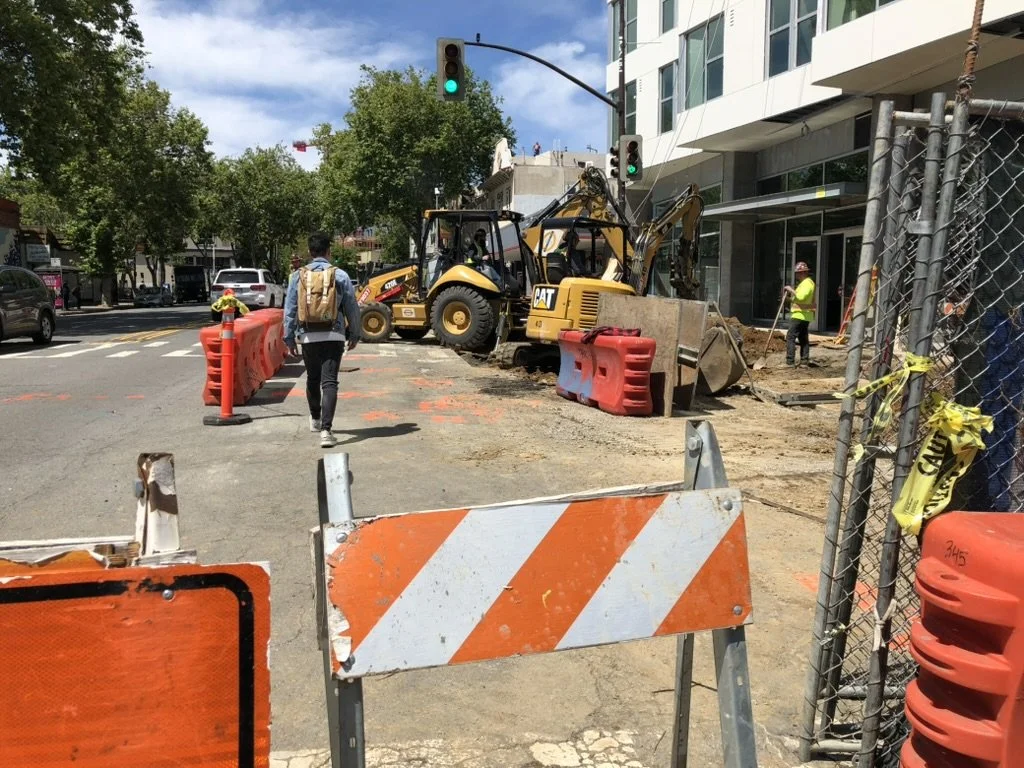
Construction Is Already Changing Telegraph Access
Campaign photo documentation shows construction equipment and barriers narrowing sidewalk and curb access on Telegraph-area blocks.[61]
Telegraph is not a blank street on a planning map.
It is where people buy food, wait for buses, walk home from class, unload deliveries, meet friends, work late shifts, and move between campus and Southside. It is also the front door for small businesses that depend on every bit of foot traffic, visibility, loading access, and customer access they can get.
That is why I need to be clear about the position I am taking.
I am for bus lanes. I am for bike lanes. I am for streets that make it easier to move without a car.
I do not support making Telegraph permanently car-free.
I want Telegraph to remain multimodal.
There are times when pedestrian traffic is highest. During those hours, Telegraph should be able to work plaza-style, with clear rules for buses, bikes, emergency access, disabled access, deliveries, small business access, and nearby residential streets.
I do support a car-free Bowditch pedestrian way.
That distinction matters because safer streets should not be delayed for anyone's preferred project. Telegraph deserves new pavement now, not after City Hall finishes studying whether a permanent car-free concept can be made to work.
The argument is simple:
Telegraph repair is being deferred while CAR FREE Telegraph remains unresolved.
Small businesses, workers, disabled users, deliveries, emergency access, and nearby residential streets are not side issues. They are the test of whether the design works.
Oakland's Telegraph experience shows that transit and bike improvements still have to be judged by real street outcomes.
A timed plaza model can respond to peak pedestrian demand without turning Telegraph into a permanent single-purpose street.
Bowditch is the better car-free corridor because it already carries bike movement and is becoming a major housing and walking street.
The political record matters because the people most affected should shape the plan before it becomes City direction.
Contents: Street repair | Small business | Transit | Bowditch | Accountability
Bowditch is where the car-free conversation makes more sense.
For years, Bowditch has been treated as a bike route on paper while the actual street has been allowed to deteriorate. A bike lane does not serve people if the pavement is broken, the street feels neglected, and the surrounding pedestrian conditions do not match the amount of housing being added nearby. Supporting bike lanes means maintaining them. Supporting bus lanes means designing them around the whole street, not treating everyone else as an inconvenience.
AC Transit is not a private company. It is an independent public transit district, created by voters and governed through its own elected board.[1][2] It belongs to the residents of the transit district, including Alameda County residents, not to Berkeley City Hall. That is exactly the point. AC Transit has a responsibility to move buses across the East Bay. Berkeley has a separate responsibility to protect small businesses, disabled access, loading, emergency response, pedestrian safety, and the residential streets where traffic goes when Telegraph stops working.
That is why small business opposition should not be dismissed as resistance to change. If a street design cuts off customer access, weakens loading, makes deliveries harder, pushes traffic onto nearby residential streets, or turns every repair into another disruption, small businesses do not experience that as an abstract planning choice. Workers experience it at the counter, in the kitchen, during the closing shift, and on the way home.
The question is not "bus lanes or no bus lanes."
The question is: who is Telegraph being designed for, who gets to shape the answer, and who absorbs the cost when the design is wrong?
The people most affected by the decision should not be the last people invited to comment on it. If they oppose the plan, that opposition should be taken seriously, not treated as a public-relations problem to get through.
I am running for Berkeley City Council in District 7, so I should be clear about where I stand. I would not support moving the current CAR FREE Telegraph concept forward as the answer for Telegraph Avenue. It creates too many foreseeable harms for small businesses, workers, disabled people, deliveries, emergency access, buses, cyclists, and nearby residential streets.
My alternative is not to abandon bus lanes or bike lanes. It is to make Telegraph work as a multimodal civic street. Telegraph should stay usable for transit, bikes, walking, deliveries, disabled access, emergency access, small business access, and limited vehicle movement. During the busiest pedestrian periods, it should be able to shift into plaza-style hours with clear access rules. Bowditch should become the car-free pedestrian-priority street because that is where major housing, bike movement, and daily walking needs are being concentrated. Channing Avenue should be studied as the better bus-priority corridor for Southside.
If elected, I will make this part of my first 100 days in office. We will make progress on repairing Bowditch. We will demand Telegraph pavement repair now. We will bring small businesses, workers, disabled users, and nearby residents to the table first, not last. And we will not let a permanent Telegraph restriction move forward until the City can answer the basic questions about traffic, loading, delivery access, disability access, emergency access, and nearby residential streets.
The Context: Housing, Street Pressure, And Road Repair
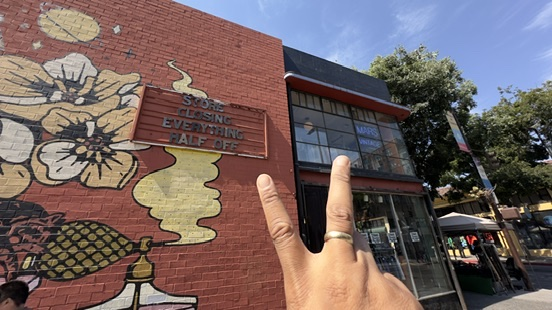
A Storefront Closure Is Not An Abstract Data Point
The City vacancy data shows Telegraph moving in the wrong direction, and this campaign photo shows what that can look like at street level.[25][55]
Southside is being asked to absorb major housing, street redesign, construction, and traffic changes at the same time.
UC is concentrating major housing around Bowditch. The Channing-Bowditch project is planned for more than 1,500 undergraduate beds, with a 26-story tower along Channing and a 14-story building along Bowditch.[15] The People's Park housing project at Haste and Bowditch is planned for more than 1,100 students, with additional permanent supportive housing on the same site.[16] UC's own housing page says two projects in construction or development will add more than 2,700 beds in the coming years.[17]
That means Bowditch is no longer just a bike route on a map. Berkeley's bicycle boulevard guidance says the route begins at the Oakland border on Hillegass, continues to Dwight, jogs onto Bowditch, and then runs to Bancroft at the edge of UC Berkeley.[14] Bowditch is already planned as a transportation corridor. The same street is also becoming one of Southside's most important housing and pedestrian corridors.
That mismatch matters. The City can describe Bowditch as bike infrastructure, but people living here can see when the actual street is not being cared for like essential infrastructure.
Telegraph has been moving through separate planning tracks for years. In 2022, the Southside Complete Streets staff report described a project meant to improve walking, biking, transit, loading, public space, and pavement conditions in Southside.[3] It also said Southside sidewalks carry some of the highest numbers of people walking in the East Bay, while limited loading zones already create operational problems for small businesses in the neighborhood.[3]
The Telegraph design question has never only been about safety. It has also been about who gets priority on the street. The 2022 recommended Telegraph concept included a bus-only lane, wider sidewalks, bollards, pedestrian-scale lighting, and public-realm amenities.[4] Former Councilmember Rigel Robinson's supplemental direction asked the City Manager to explore limits on private automobiles between Bancroft and Dwight, while the Transportation Commission asked staff to show how the design could work as a car-limited street with a transit lane.[5]
South of Dwight, the City is also advancing a separate Telegraph Multimodal Corridor Project between Dwight and Woolsey. The 2024 City Manager and Public Works item proposed protected bike lanes and converting one vehicle lane in each direction into bus-only lanes with boarding islands.[6]
The immediate problem is road repair. The July 7, 2026 Five-Year Street Rehabilitation and Measure FF plan says Telegraph Avenue was deferred because of the CAR FREE Telegraph referral and future corridor configuration.[9] In plain language, the street that needs repair is being held back while the City decides what kind of street it wants Telegraph to become.
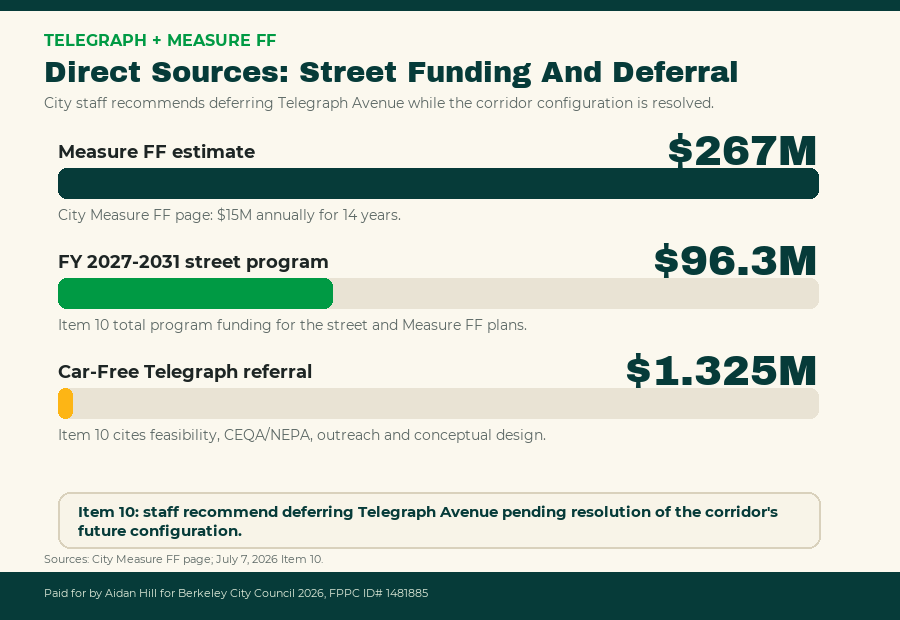
Telegraph Repair Was Deferred
The July 7, 2026 Measure FF street plan says Telegraph Avenue repair was deferred because the CAR FREE Telegraph referral left the corridor configuration unresolved.[9]
That is backwards. We will never delay safer streets. Telegraph deserves new pavement now, not when a preferred project is finished.
Merchant concerns were already on the record. The 2022 supplemental material said the public process captured small business concerns about commercial loading. It also said small businesses on Telegraph do not have back alleys, so commercial loading and refuse collection happen on the main street itself. Fire access was identified as critical, and merchant frustration over on-street parking was already known.[5]
Southside circulation was already fragile. The Southside Plan describes the neighborhood as a mainly one-way grid and says drivers may seek alternate routes through adjacent neighborhoods when east-west capacity is reduced.[24] The same plan calls for changing Dana and Ellsworth to two-way traffic to calm traffic and reduce circuitous travel, and says circulation changes should be evaluated for impacts on transit, pedestrian and bicycle safety, and traffic volume.[24]
Durant already shows what happens when delivery work, bus movement, curb access, and development pressure collide on the ground. A 2021 City budget referral said DoorDash and UberEats drivers often parked in a travel lane to pick up orders, and that pandemic takeout demand made congestion worse.[28] A 2023 City report said Durant was frequently congested because delivery drivers double-parked, especially between Telegraph and Bowditch, harming transit reliability. The same report also described Durant as a major vehicular access corridor with curbside parking and loading zones supporting residents, businesses, and visitors.[29] Berkeley later changed curb rules on the 2400 and 2500 blocks of Durant to reduce double-parking conflicts with the future bus-only lane and add short-term and commercial loading.[30] AC Transit says the Durant quick-build converted one general-purpose lane to a bus-only lane, and that the project has been operational since June 2025.[31]
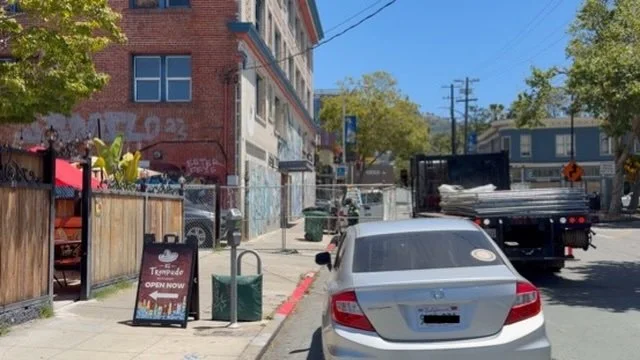
Dwight Access Is Already Constrained
Campaign photo documentation near El Trompudo shows curb pressure and construction-related access limits around Dwight and Telegraph.[51][61]
Dwight is already absorbing the kind of pressure the City needs to study before it adds another layer. The State CEQAnet posting for the City of Berkeley's 2449 Dwight Way project describes an eight-story, 63-unit mixed-use project at Dwight Way and Telegraph Avenue.[48] Around that same corner, El Trompudo's own ordering page now lists a Berkeley location at 2441 Dwight Way, and local food coverage reported the Berkeley location open in late May 2026.[49][50] As a Dwight resident, I am already seeing construction, traffic, and access problems near that corner, including direct street access disruption around El Trompudo.[51]
That is the real context.
This is not a fight against transportation improvements. It is a fight over whether Southside gets complete neighborhood planning, or whether one preferred street vision moves forward while the neighborhood absorbs the combined impact.
If Telegraph becomes harder to use without a side-street traffic plan, traffic will not disappear. It will move onto Bowditch, Dana, Ellsworth, Channing, Haste, Dwight, and nearby residential blocks.
If loading access is weakened without a real delivery plan, small businesses will feel it first.
If disabled access and paratransit access are treated as design details instead of starting points, people with mobility needs will be asked to navigate the consequences.
If Bowditch is planned as a bike route but not as a pedestrian-first housing corridor, the City will miss what is actually changing on the ground.
And if road repair keeps waiting for a future corridor plan, Southside will keep living with the delay.
That is why the better starting point is a managed multimodal civic street model: timed plaza hours during peak pedestrian periods, transit access, delivery windows, emergency access, disabled access, limited vehicle access, pedestrian safety, bike safety, and residential street protections designed together.
Telegraph should work for the whole neighborhood, not just one transportation concept.
What The Record Shows
The public record shows that Telegraph's current direction did not come out of nowhere.
In 2022, the City Manager brought forward the Southside Complete Streets conceptual designs. The staff report said the project was meant to improve walking, biking, transit, loading, public space, and pavement conditions in Southside.[3] It also acknowledged that limited loading zones were already creating operational problems for small businesses in the neighborhood.[3]
For Telegraph between Dwight and Bancroft, the recommended concept was Option 4: a curbless street, a northbound travel lane, a bus-only lane, wider sidewalks, pedestrian-scale lighting, bollards, and public-realm amenities.[4] The same report said a substantial number of public comments supported a car-free design, but that limiting or eliminating private vehicle access was outside the scope of that project.[4]
Former Councilmember Rigel Robinson then submitted supplemental direction asking the City Manager to explore limits on private automobiles on Telegraph between Bancroft and Dwight. The supplemental material also cited the Transportation Commission's recommendation that staff show how Telegraph Option 4 could operate as a car-free street with a transit lane.[5]
The problem is not a curbless street by itself. A curbless street can work if loading, disability access, emergency access, transit movement, trash pickup, bike movement, and pedestrian space are actually solved. The problem is using a curbless design as a bridge to permanent CAR FREE Telegraph before those operating questions are answered.
That matters because the hard questions were already visible in 2022.
How would loading for small businesses work? How would disabled access work? How would buses move? How would fire access work? How would refuse collection work? How would bikes, pedestrians, and delivery vehicles share the same limited space? These are not late objections. They are the basic questions that should decide whether the design works.
In 2024, a separate City Manager and Public Works item authorized grant applications for the Telegraph Multimodal Corridor Project between Dwight and Woolsey. That project proposed converting one vehicle lane in each direction into bus-only lanes with boarding islands, while adding protected bike lanes.[6]
In 2026, Councilmember Cecilia Lunaparra authored the CAR FREE Telegraph budget referral, seeking $1,325,000 to study limiting car access and develop pedestrian-centered design concepts between Bancroft and Dwight.[7] The minutes show Mayor Adena Ishii, Councilmember Mark Humbert, and Councilmember Brent Blackaby were added as co-sponsors, and the recommendation was approved on consent.[8]
Then, on July 7, 2026, the City adopted a five-year street rehabilitation plan that deferred Telegraph between Bancroft and Dwight while the future corridor configuration remains unresolved.[9]
So yes, there is accountability here. This was not one random traffic idea. It moved through staff reports, commission recommendations, grant applications, Council referrals, budget decisions, and consent approvals.
Why Small Businesses Were So Publicly Against It
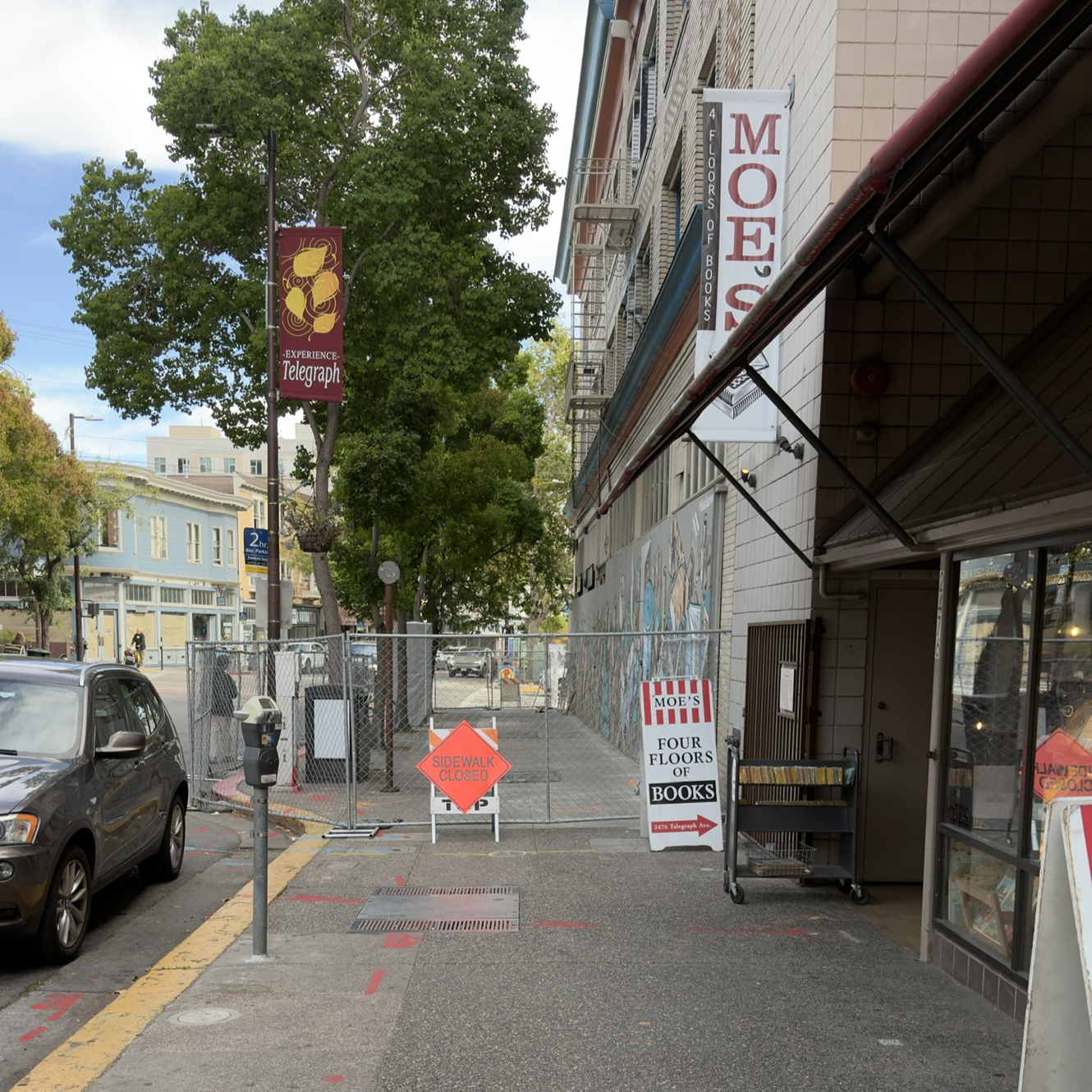
Moe's Shows Why Sidewalk Access Matters
Campaign photo documentation shows sidewalk closure fencing and storefront access constraints near Moe's Books on Telegraph.[56]
Small business opposition to a permanent car-limited Telegraph model was not abstract.
The Cal Alumni Association article reported that Moe's Books owner Doris Moskowitz was concerned that banning cars would make it harder for people to bring used books to sell, and that the Telegraph Business Improvement District had expressed disapproval because the proposal lacked clear merchant support.[58]
For many small businesses on Telegraph, the street is the loading dock. The 2022 record says these businesses do not have back alleys, so commercial loading and refuse collection happen on Telegraph itself.[5] That means lane design is not just a map problem. It affects deliveries, trash pickup, workers arriving for shifts, disabled access, customer pickup, fire access, and whether a small business can keep functioning during construction or after a permanent redesign.
The traffic problem is also basic. Durant is part of a one-way circulation pattern. Dana and Ellsworth have long been part of the City's circulation debate. The Southside Plan explicitly considered converting Dana, Ellsworth, Bancroft, and Durant from one-way to two-way because Southside travel is already circuitous.[24] If Telegraph is effectively cut off as a usable private-vehicle lane without a full circulation fix, drivers still have to go somewhere. The likely pressure points are Dana, Ellsworth, Bancroft, Channing, Haste, Bowditch, College, and the blocks around them. Those are also the streets next to major new housing pressure.
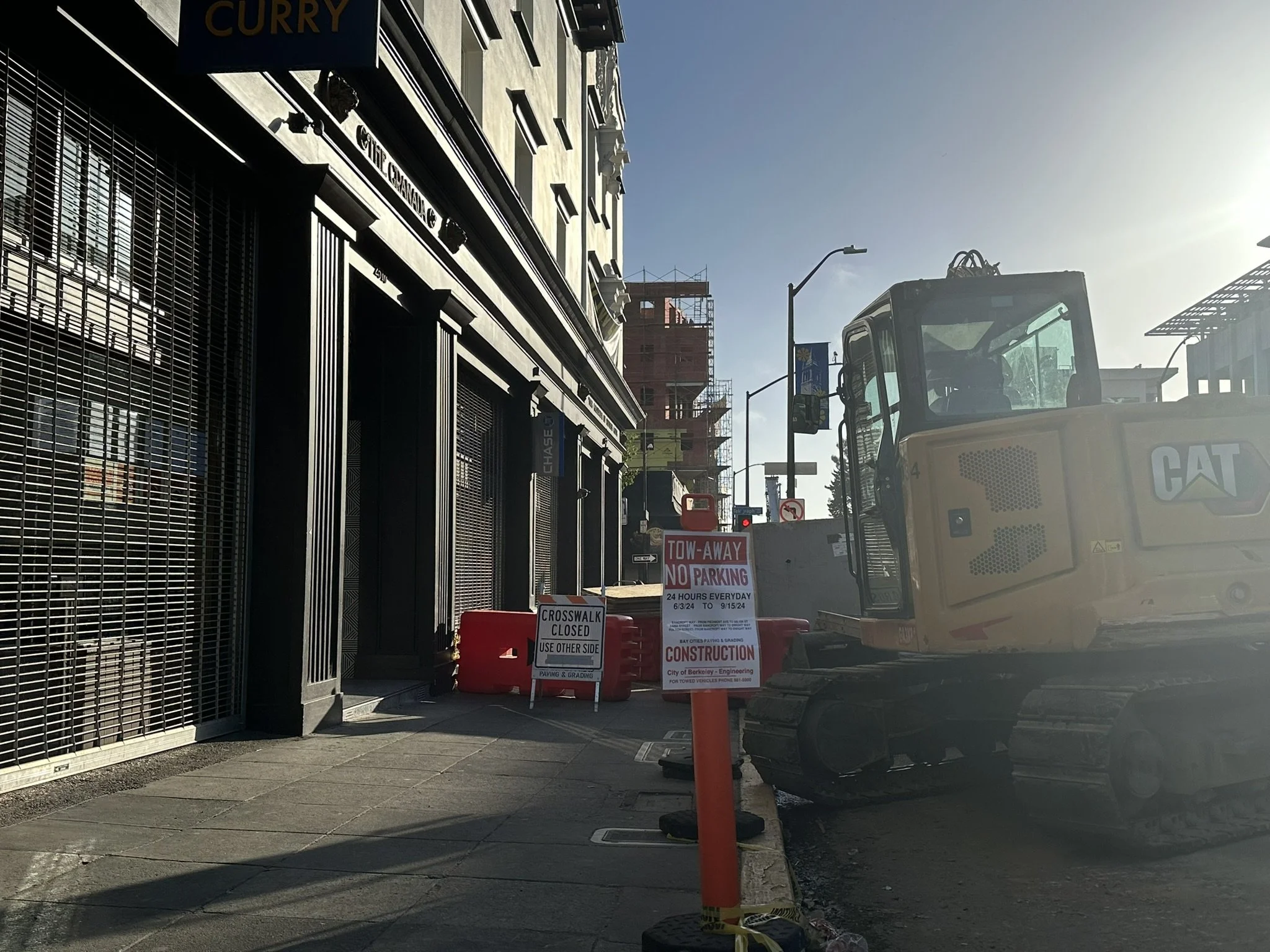
Bancroft Is Already Carrying Construction Pressure
Campaign photo documentation shows Bancroft construction equipment, tow-away signage, crosswalk closure signage, and storefront access constraints.[53][60]
That matters because Bancroft is not spare capacity. The City says Bancroft now has protected bike infrastructure and dedicated bus-only lanes, and that Bancroft and Durant are the primary east-west roads with transit-only lanes in Southside.[60] If Telegraph becomes harder to use, Bancroft will carry even more pressure because it is one of the only ways out of upper Southside.
Durant is the warning sign. The City already documented the post-COVID delivery economy there. In 2021, a City budget referral said gig drivers working for DoorDash or UberEats often parked in a travel lane to pick up orders, and that congestion had been made worse by the pandemic increase in takeout orders.[28] In 2023, another City report said delivery-driver double parking on Durant, especially between Telegraph and Bowditch, was hurting transit reliability.[29]
The answer was not simple. AC Transit moved forward with the Durant Transit Lane Quick Build, which converted one general-purpose lane into a bus-only lane between Fulton and College.[31] Berkeley then had to create a separate Durant curb-management strategy to reduce double-parking conflicts with that bus-only lane by changing curbside parking and adding short-term and commercial loading zones.[30]
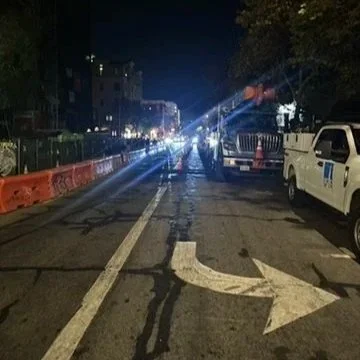
Durant Shows The Street Pressure
Campaign documentation and City records show Durant Avenue construction, lane controls, loading conflicts, bus movement, and post-COVID delivery pressure.[28][29][30][31][54]
That is documented harm: not harm caused by buses, and not harm caused by delivery workers alone. It is harm caused when the City treats transit design, delivery work, curb access, and small business survival as separate problems. The post-COVID model means delivery is not a side issue. It is how ordinary workers earn money and how many small businesses keep orders moving. If the street design does not make legal space for that reality, the pressure does not disappear. It becomes double parking, bus delay, blocked access, worker stress, and conflict between people who are all trying to get through the day.
Durant is also being asked to absorb major housing pressure. The February 23, 2026 Council agenda described the 2425 Durant proposal as demolition of three existing two-story residential buildings, including 19 rent-controlled units, and construction of a 20-story residential building with 169 units.[32] Whether someone supports or opposes that project, it shows why street design cannot be separated from housing pressure, construction disruption, delivery work, and small business survival.
That is why this is a safety issue, not just a small business issue.
A design that pushes cars toward Bancroft, Channing, and Haste would push more vehicle pressure toward the same blocks where UC is adding major student housing and where more people will be walking every day. A design that pushes traffic toward Bowditch and College would add pressure to streets already carrying campus access, bike traffic, residential life, and student movement. The City should model that before it asks small businesses and residents to live with it.
Dwight residents should not be treated as an afterthought either. I live on Dwight. We are already living with traffic, construction, detours, and access problems around Dwight and Telegraph. A new small business like El Trompudo should not have to open into a street environment where simple direct access is already being disrupted. Before Berkeley adds a permanent Telegraph restriction north of Dwight, the City should explain what happens to the people and small businesses on Dwight who will carry the spillover.
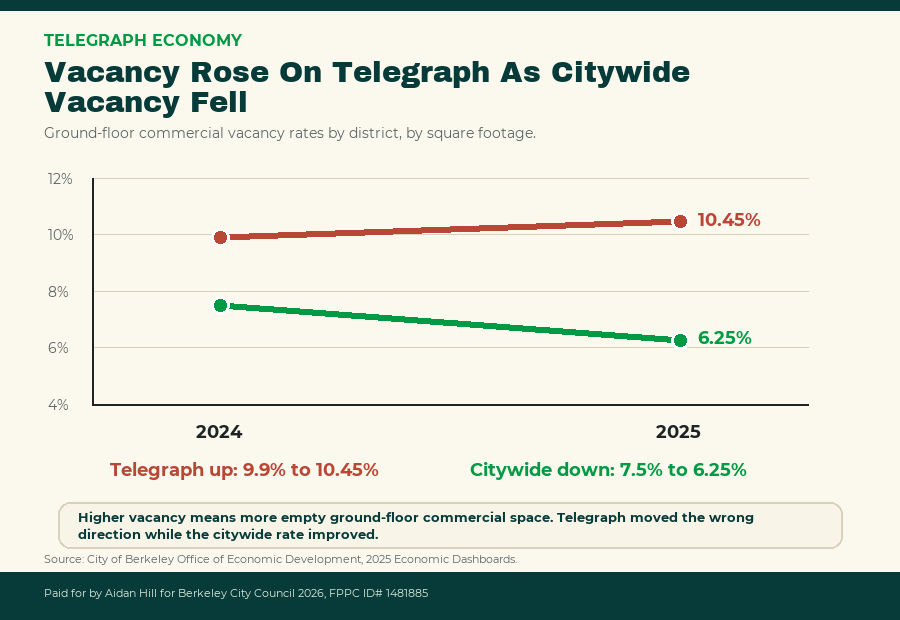
Telegraph Vacancy Moved The Wrong Way
Berkeley's 2025 Economic Dashboards show citywide ground-floor vacancy falling while Telegraph vacancy rose from 9.9 percent in 2024 to 10.45 percent in 2025.[25]
The post-COVID small business context matters too. Berkeley's 2025 Economic Dashboards say citywide ground-floor commercial vacancy fell from 7.5 percent to 6.25 percent, while Telegraph's vacancy rate rose from 9.9 percent in 2024 to 10.45 percent in 2025.[25] That does not prove any one street design caused the problem. It does show Telegraph is not in a position to absorb avoidable disruption casually.
That is the condition of Telegraph under current District 7 leadership. It does not prove Councilmember Lunaparra caused the vacancy increase. It does show that Telegraph has not kept up with the citywide commercial recovery while her CAR FREE Telegraph referral moves through City process.[7][25]
People working long, low-wage shifts should not be treated as an afterthought in a transportation experiment. A cashier, cook, server, cleaner, delivery worker, shop owner, or closing-shift worker should not have to absorb the cost of a design process that did not take their survival seriously.
This is where City process can become unfair even when it uses the language of public input. The people most affected are often the people with the least spare time to attend meetings, chase City staff, read planning packets, or translate street-design language into what it means for the next shift. Some are working in kitchens. Some are trying to communicate through layers of staff and process. Some are dealing with bad conditions while trying to protect their families and keep a job. Their experience should count as expertise. Their opposition should count as evidence.
The City knew these questions in 2022. The record says so. The question now is whether Berkeley has learned from that record, or whether the same concerns will be acknowledged, set aside, and rediscovered only after the damage is done.
Transit Design Still Has To Answer Neighborhood Questions
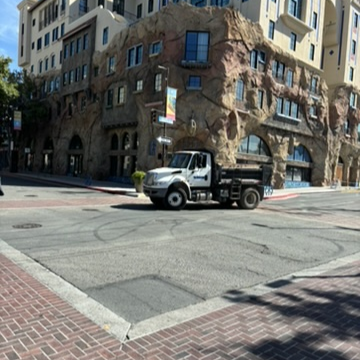
Haste And Telegraph Show The Maintenance Problem
Campaign photo documentation shows visible pavement and sidewalk wear at Haste and Telegraph.[57]
Oakland's experience on Telegraph is useful because it shows the tradeoff.
Oakland's 2021 evaluation of Telegraph in Temescal found that the project lowered vehicle traffic and speeds. Daily vehicle volume dropped 35 percent in the Temescal segment, and average speed dropped from 24 mph to 19 mph.[10]
But the same evaluation found that drivers yielded to pedestrians less often at Telegraph and 48th Street after construction. In the morning peak, yielding fell from 63 percent to 29 percent. In the evening peak, it fell from 57 percent to 52 percent.[11]
That does not mean the project failed. It means safety is not one number. A street can be slower and still have pedestrian conflicts. A design can help one mode and still create problems for another.
Oakland also looked at bus-only lanes on Upper Telegraph and rejected that option. Staff found the road diet option had more pedestrian safety benefits, more accessibility features, and more commercial parking and loading than the bus-only lane design.[12]
The reason is important. Oakland staff wrote that separating the bus lane well enough to keep private vehicles out was largely infeasible. That could create unsafe, unpredictable driving, reduce expected transit benefits, and produce strong public pushback.[13] Staff also found the bus-only lane option would remove 60 to 65 percent of parking and could hurt commercial loading, accessible parking, paratransit access, and pedestrian safety.[13]
That is the lesson Berkeley should take seriously.
If a permanent street redesign creates new conflicts, pushes cars into residential streets, weakens loading access, or makes the street harder for disabled people to use, it should not be treated as the default just because it includes transit infrastructure.
Telegraph Needs A Multimodal Civic Street Model
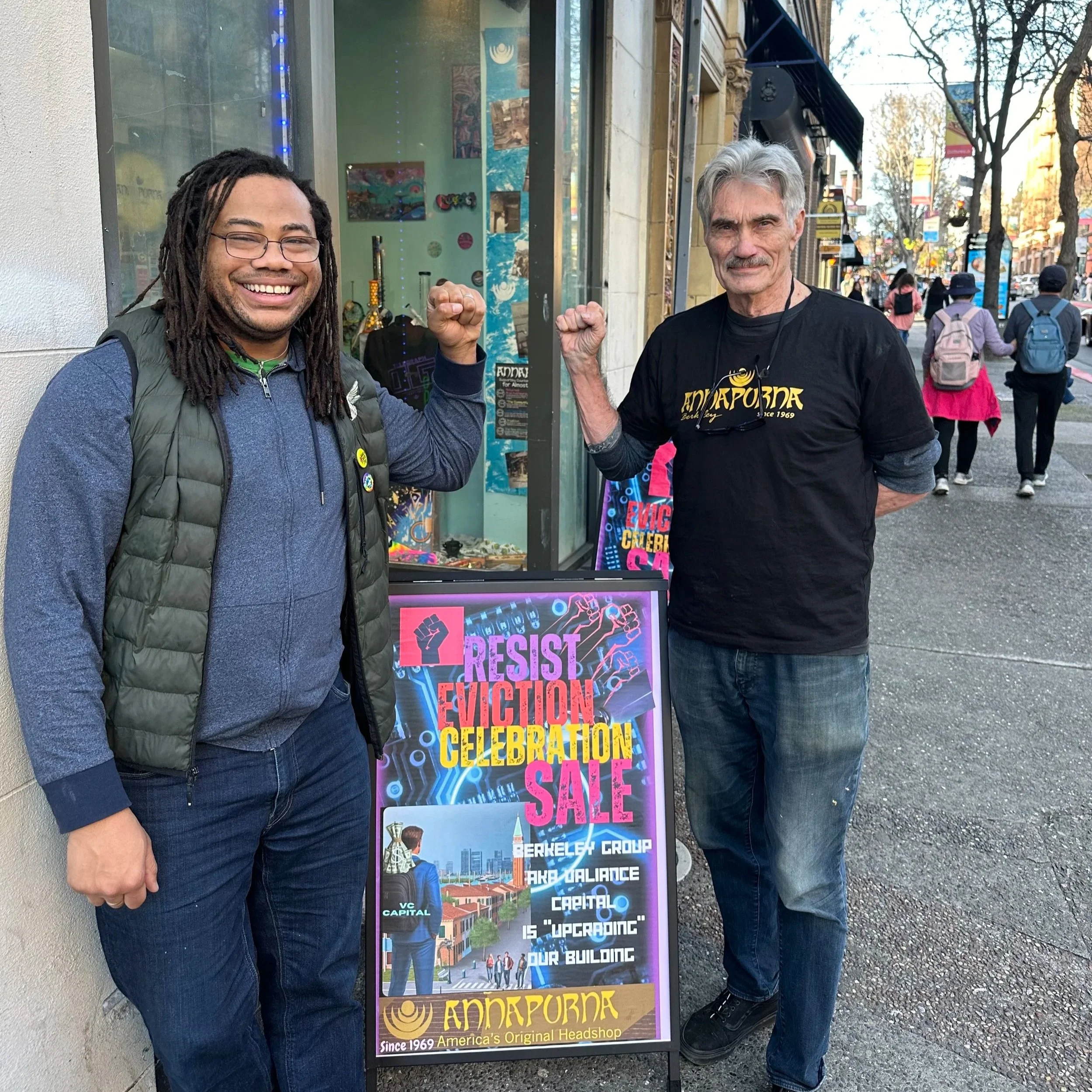
Annapurna Shows What Is At Stake
Campaign photo documentation shows an anti-eviction storefront sign on Telegraph. Street planning has to account for small businesses already fighting to stay.[63]
Telegraph should not become a permanent single-purpose street with small businesses arranged around it.
Telegraph should remain multimodal.
That means the City can still create plaza-style hours when pedestrian traffic is highest, while keeping safer crossings, bus access, bike access, delivery windows, emergency access, disabled access, limited vehicle movement, and curb rules that actually match how the street works.
A bus lane can move buses. A timed plaza can support heavy pedestrian use. A multimodal civic street asks what the whole street needs at different times of day.
Small businesses do not survive on theory. They need people to notice them, enter them, pick up food, receive deliveries, and come back. Workers need to get there. Disabled residents and visitors need usable access. Delivery drivers need legal places to stop. Buses need to move. People walking need to cross without guessing what the next vehicle is going to do.
If Telegraph is changed without a traffic plan for Bowditch, Dana, Ellsworth, Channing, Haste, Dwight, and the nearby residential blocks, the pressure will not disappear. It will move.
That is not pedestrian safety. That is displacement of traffic into the neighborhood.
As a District 7 candidate, my position is that Telegraph should not be forced into a permanent car-restriction model just because that has become the preferred direction inside City process. I believe the better public proposal is to manage Telegraph as a multimodal civic street with timed plaza-style hours, study Channing Avenue as the bus-priority corridor, and redesign Bowditch as the pedestrian-first housing and bike corridor that Southside is already becoming.
That proposal should still go through public process. The difference is that it starts from the people and streets carrying the impact, not from one preferred concept that small businesses and nearby residents are expected to accept after the fact.
Bowditch Is The Other Half Of This
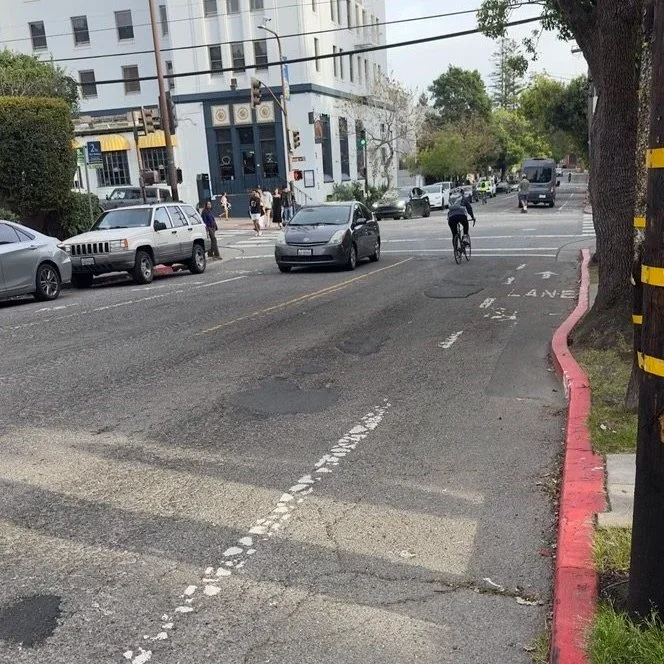
Bowditch Needs Repair And Priority
The City identifies Bowditch and Hillegass as a bike boulevard connection to UC, while campaign photo documentation shows visible cracking in the Bowditch bike lane.[14][33]
Bowditch cannot be treated as an afterthought.
The City's own bicycle boulevard guidance describes a Bowditch/Hillegass bike boulevard that begins at the Oakland border on Hillegass, continues to Dwight, jogs onto Bowditch, and then runs to Bancroft at the edge of UC Berkeley.[14] The same guidance says Bowditch already has bike lanes for its full length between Dwight and Bancroft and serves UC campus destinations, offices, and residential halls.[14]
That is part of why this hurts. If Berkeley is serious about bike lanes, Bowditch should not be allowed to sit in disrepair while officials talk about bigger transportation visions somewhere else. A painted lane is not enough. The pavement, crossings, lighting, visibility, pedestrian space, and surrounding land use all matter.
At the same time, UC is concentrating major housing around Bowditch.
UC's Channing-Bowditch project is planned for the southwest corner of Channing and Bowditch, with more than 1,500 undergraduate beds, a 26-story tower along Channing, and a 14-story building along Bowditch.[15] UC's People's Park housing project at Haste and Bowditch is planned for more than 1,100 students, with additional permanent supportive housing on the site.[16] UC's own housing page says two projects in construction or development will add more than 2,700 beds in the coming years.[17]
That makes Bowditch more than a bike route.
It is becoming a housing street. A walking street. A disability-access street. A delivery street. A safety-at-night street.
If the City can plan Bowditch/Hillegass as a connected bike corridor, it can also plan Bowditch as a pedestrian-first housing corridor.
The Lineage Behind CAR FREE Telegraph
Bike Access Cannot Be An Afterthought
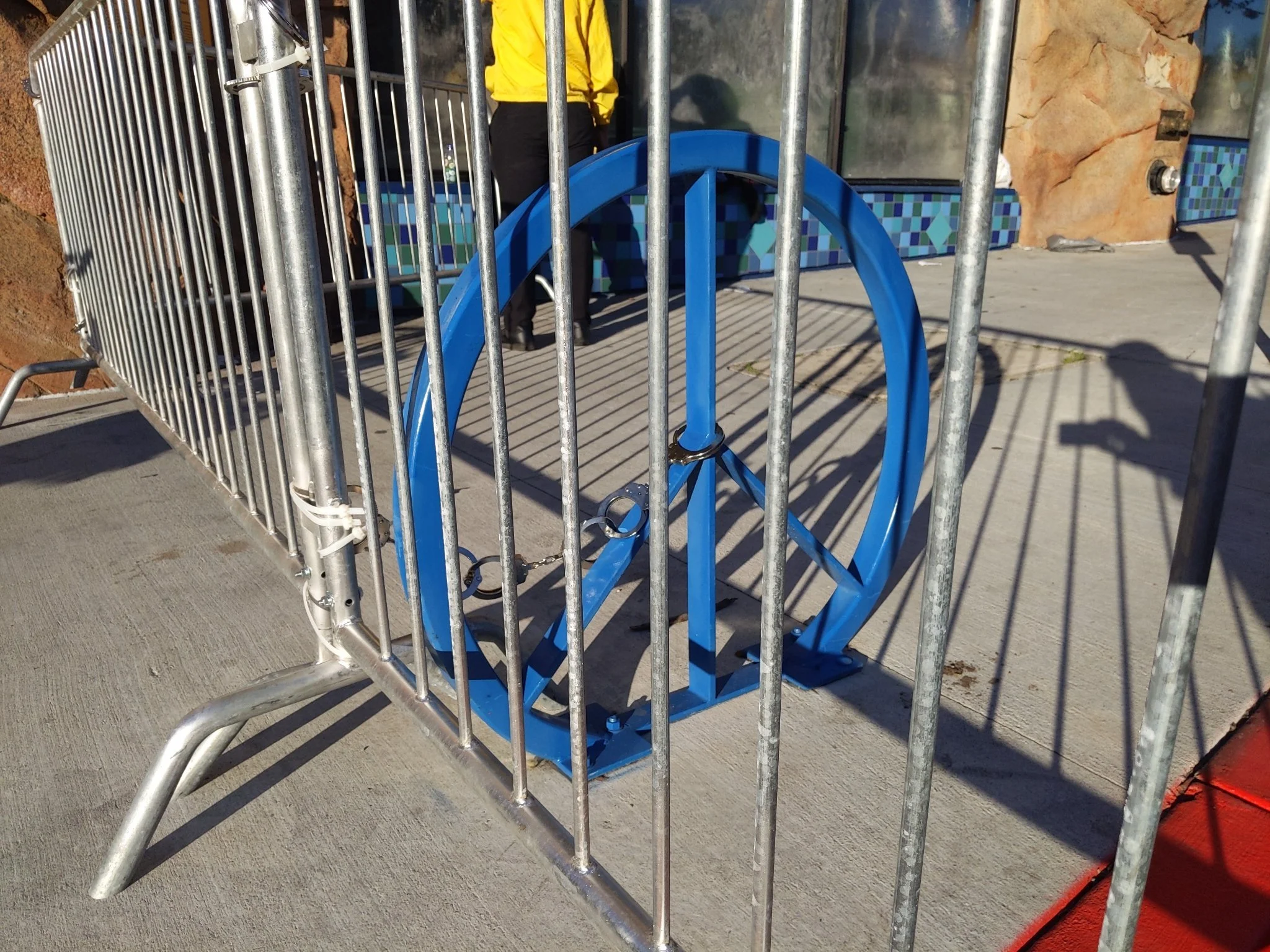
Campaign photo documentation shows bicycle infrastructure blocked behind construction barriers, which is exactly why street work needs a real access plan.[65]
There is also a political history here.
The group most visibly associated with the permanent car-free Telegraph push is Telegraph for People. Direct sources describe it as a student-led organization. They also say Sam Greenberg and Brandon Yung co-founded it, and that Greenberg and Yung developed Option Five, the plan for a four-block pedestrian plaza with a dedicated bus lane.[58][59]
Former Councilmember Rigel Robinson did not create Telegraph for People in the direct sources I found. But he did champion its project from City Council. A Cal Alumni Association article described Robinson and Telegraph for People as long-time advocates for a permanent car-free Telegraph, quoted Robinson calling Telegraph redesign his "most pathological fixation," and said Berkeley City Council supported Robinson's recommendation to begin exploring the idea in February 2022.[58]
That City record matches the official paper trail. Former Councilmember Rigel Robinson brought forward a 2019 referral to implement shared streets concepts from the Telegraph Public Realm Plan, according to the City's 2022 Southside Complete Streets report.[18] In 2022, his supplemental direction helped keep the car-free Telegraph concept moving by asking staff to explore limits on private automobiles between Bancroft and Dwight.[5]
Robinson also publicly supported UC's People's Park housing project. In a 2020 San Francisco Chronicle op-ed with then-Mayor Jesse Arreguin and Councilmember Lori Droste, he argued for a new People's Park that included student housing, supportive housing, and open space.[19]
IKE Kiosks Raised Public-Space Data Questions
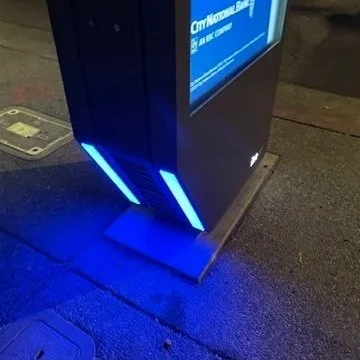
The City approved IKE kiosk locations touching Telegraph, and direct IKE privacy materials describe sensors, cameras, Wi-Fi information, and related data practices.[20][37][52][62]
And in 2022, Robinson was on the Council when the consent calendar adopted the IKE Smart City kiosk Phase Two locations.[20]
That IKE vote matters because the kiosks were not just static signs. Berkeley's 2022 staff report described IKE as dual-sided touchscreen kiosks in the public right of way that can provide real-time transit information, business and nonprofit directories, social services, civic resources, 311 access, emergency 911 phone calls, public polling, phone handoff for directions, Wi-Fi, job postings, public safety announcements, weather, and advertising.[37] The Phase Two action approved 22 locations citywide. For Telegraph specifically, Berkeley already had three installed Phase One kiosks at Telegraph and Channing, Telegraph and Haste, and Telegraph and Dwight. Phase Two added two Telegraph commercial-district locations, Telegraph and Blake and Durant and Bowditch, plus a gateway location at Ashby and Telegraph.[37] Counted narrowly, that is five kiosks in the Telegraph district. Counted by every approved location touching Telegraph, it is six.
The privacy concern was not invented later. In 2019, when Council approved Phase One, the minutes show Robinson voting yes and say Council also directed staff to draft an amended agreement with IKE about limits on third-party data sharing and privacy protection.[38] IKE's Berkeley privacy policy says that if a personal device has Wi-Fi turned on near a kiosk, the device may share its MAC address with the kiosk across the Wi-Fi signal. The same Berkeley policy says IKE collected identifiers, kiosk usage data, and general geolocation data, and disclosed those categories to third-party partners, while also saying IKE does not sell personal information, store that technical information, store browser history, or track websites visited.[39] IKE's general privacy policy goes further: it says kiosks may have environmental sensors, may be equipped with cameras that capture images of the area around the kiosk, may retain camera footage for up to 15 days unless needed to investigate an incident, and lists biometric information limited to a user's face captured on the kiosk camera when the camera is activated by the user.[52] In plain language, this was not just street furniture. It was data-gathering and sensor-enabled public infrastructure placed in the middle of commercial and pedestrian life.
There is also a direct succession record. The City report confirming the April 16, 2024 special election says Robinson resigned on January 12, 2024, creating the District 7 vacancy, and that the special election declared Cecilia Lunaparra elected to the District 7 seat for the term ending November 30, 2026. The same certified result says Lunaparra received 291 votes, James Chang received 198 votes, and 493 ballots were cast in District 7.[34] A City commission roster dated April 15, 2024 also lists Lunaparra as Robinson's District 7 appointee to the Environment and Climate Commission, with a term start of June 21, 2022.[35]
The continuity is visible. Telegraph for People organized visible outside pressure. Robinson translated the idea into Council direction. Lunaparra was quoted by the Daily Californian as a Telegraph for People member, later became Robinson's successor in District 7, and then authored the CAR FREE Telegraph budget referral herself.[7][34][35][59]
The point is not that one person controls everything. The point is that a small circle can turn a preferred street vision into City direction through advocacy groups, referrals, staff work, commission appointments, budget items, grant applications, and successor politics. At that point, constituents have a right to ask who had access to shape the plan, who aligned with it, and who is expected to live with the consequences.
The Lunaparra Approval And Micael Continuity
The 2026 District 7 race now has its own connection to this record.
The official commission roster dated July 2, 2026 lists Commissioner Micael as the District 7 member of the Housing Advisory Commission, appointed by Councilmember Lunaparra. The same roster marks Micael as vice chair. The roster also describes the Housing Advisory Commission as the body that advises Council on Housing Trust Fund allocations.[21]
On November 6, 2025, the Housing Advisory Commission voted to recommend that City Council extend funding reservations for several Housing Trust Fund projects. That recommendation included Supportive Housing in People's Park at 2556 Haste, with a reservation of $14,359,593. The minutes show Micael voting yes with the other present commissioners.[22]
That record should be described carefully. Micael did not vote to approve the People's Park project, and Micael did not vote to approve the City funding extension. HAC is advisory. Its vote was narrower: it recommended that Council extend the funding reservation for the supportive-housing component at 2556 Haste.
People's Park Was Living Public Space
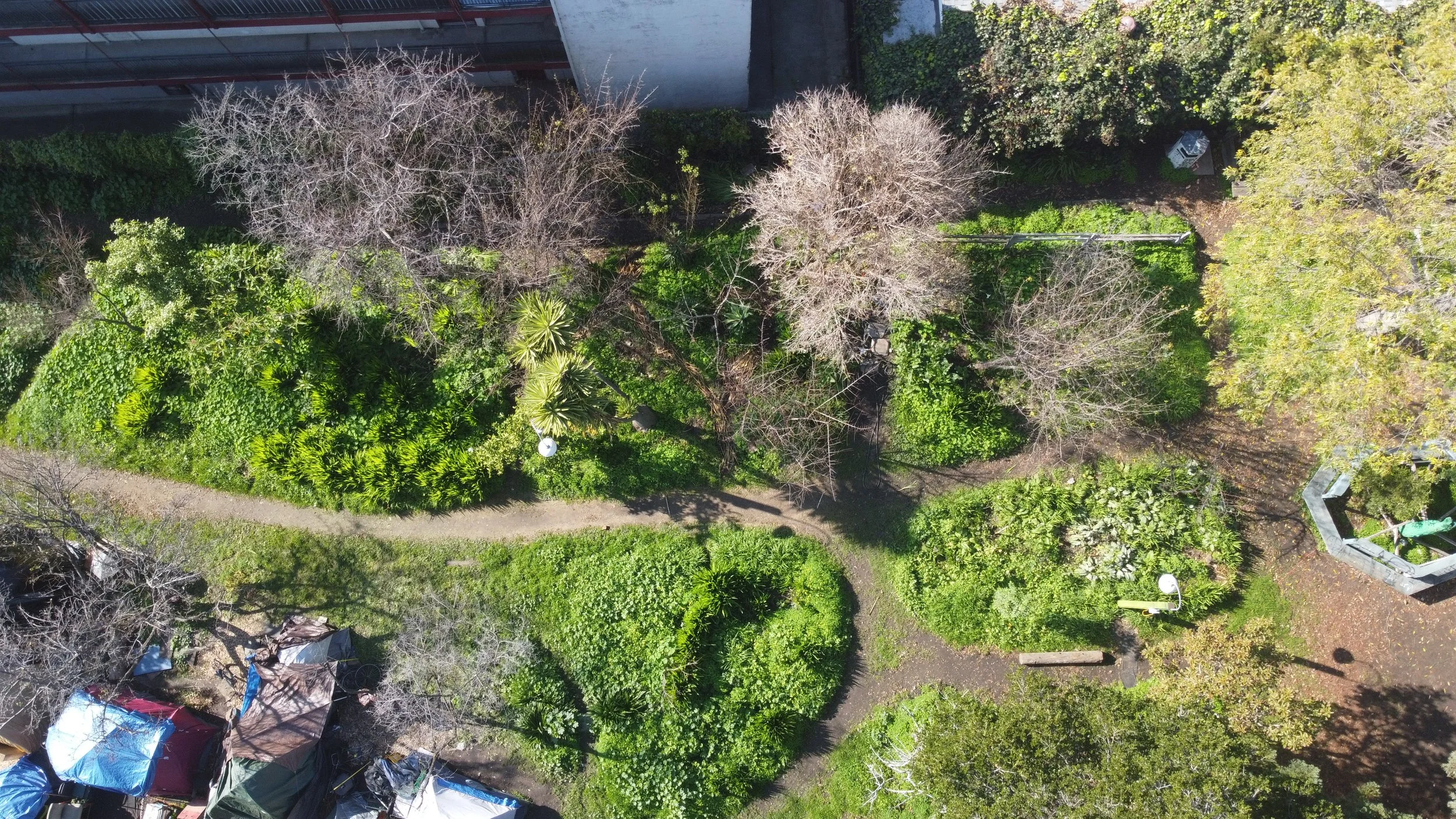
Campaign aerial documentation shows People's Park as green public space before the later construction footprint.[64]
The Council approval came later. On February 10, 2026, Council adopted the consent calendar except Item 3 in one motion, with the vote recorded as all ayes. Item 10 on that consent calendar adopted Resolution 72,124, extending Housing Trust Fund reservations, including $14,359,593 for Supportive Housing in People's Park. Lunaparra was present for that meeting.[27]
That is the accountability point. Micael was part of the advisory recommendation as Lunaparra's appointee. Lunaparra was the elected Councilmember present for the Council approval. And Micael's own campaign website says he is endorsed by Councilmember Lunaparra and will continue her Council legacy.[21][23][27]
Voters deserve to know that.
Councilmember Lunaparra is not a neutral bystander in the Telegraph question. She authored the CAR FREE Telegraph referral. She was also present when Council adopted the consent calendar that approved Resolution 72,124 extending the Supportive Housing in People's Park funding reservation. Her District 7 appointee on HAC was part of the advisory recommendation that sent that funding-extension item forward.[7][21][22][27]
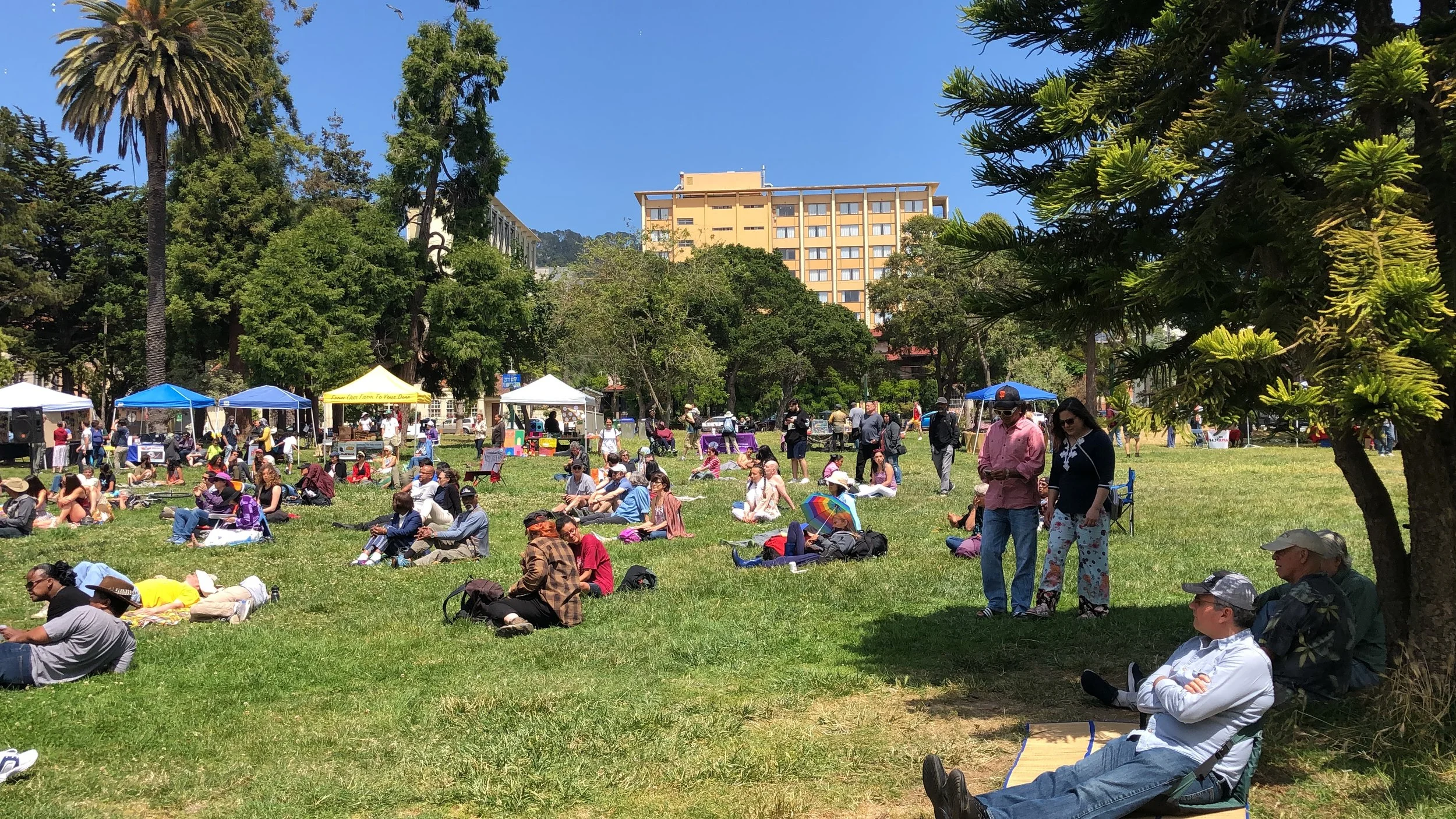
That matters because People's Park is not an empty lot in the public record. The National Register materials describe the west end of the park as a community garden with raised beds, fruit trees, compost bins, seating areas, bulletin boards, and picnic tables. They describe Council Grove as a traditional meeting place for People's Park Council, where decisions about the park were customarily made within the park itself. They also describe the park as a place of refuge for poor and homeless people, with free meals served by Food Not Bombs and Catholic Worker as part of a tradition connected to the Black Panthers' free food programs.[26]
People's Park Was Used By The Public
National Register materials describe People's Park as a community garden, meeting place, refuge, free-meal site, and part of Berkeley's Black Panther Party history.[26][64]
It also was not the only place UC could make choices. UC could marshal major resources for other campus priorities. The Gateway is a 367,270-square-foot computing and data science facility, seeded by a $252 million gift and described by UC Berkeley as a campus hub for AI and computing.[40][41] UC's own parking materials list a long set of campus parking lots and garages, including Southside-facing facilities such as Underhill Garage, Unit I Lot, Unit II Lot, Dwight Way Lot, Ellsworth Structure, Lower Sproul Garage, and the RSF Garage.[42] At Oxford and Bancroft, UC approved a beach volleyball project that replaces an existing parking lot with five sand courts, lighting, a public address system, spectator space, and a team building.[43]
That does not mean every parking lot is automatically a better housing site. It means the honest sentence is not "there was no other possible choice." Even the court record shows the alternatives issue was real. The California Supreme Court opinion notes that the Court of Appeal found UC's environmental review failed to justify not considering alternative locations for the People's Park project. The Supreme Court later reversed after Assembly Bill 1307 changed the CEQA rules for residential and mixed-use housing projects at public higher education institutions.[44]
That is why accountability has to be plain. UC chose this site. UC defended this site. Berkeley officials also had choices at every stage. They could write letters, request agenda items, ask UC to preserve the park, request alternative sites, or insist on a real hearing before City money and City partnership moved forward. On May 19, 2026, the City Council minutes show Councilmember Lunaparra present, 21 speakers on the consent calendar, and then adoption of the consent calendar in one motion, with Item 6 adopted as Resolution Nos. 72,273 and 72,274.[45] The staff report for that item said the City was jointly applying with SAHA for Homekey+ funds for Supportive Housing in People's Park and that the project would rely on the City's $14,359,593 Housing Trust Fund reservation as the required match.[46]
That is a choice. Not just UC's choice. A City choice too. Lunaparra approved the Council action after public comment was taken, and after the HAC record had already included public dissent on the same funding chain.[22][36][45]
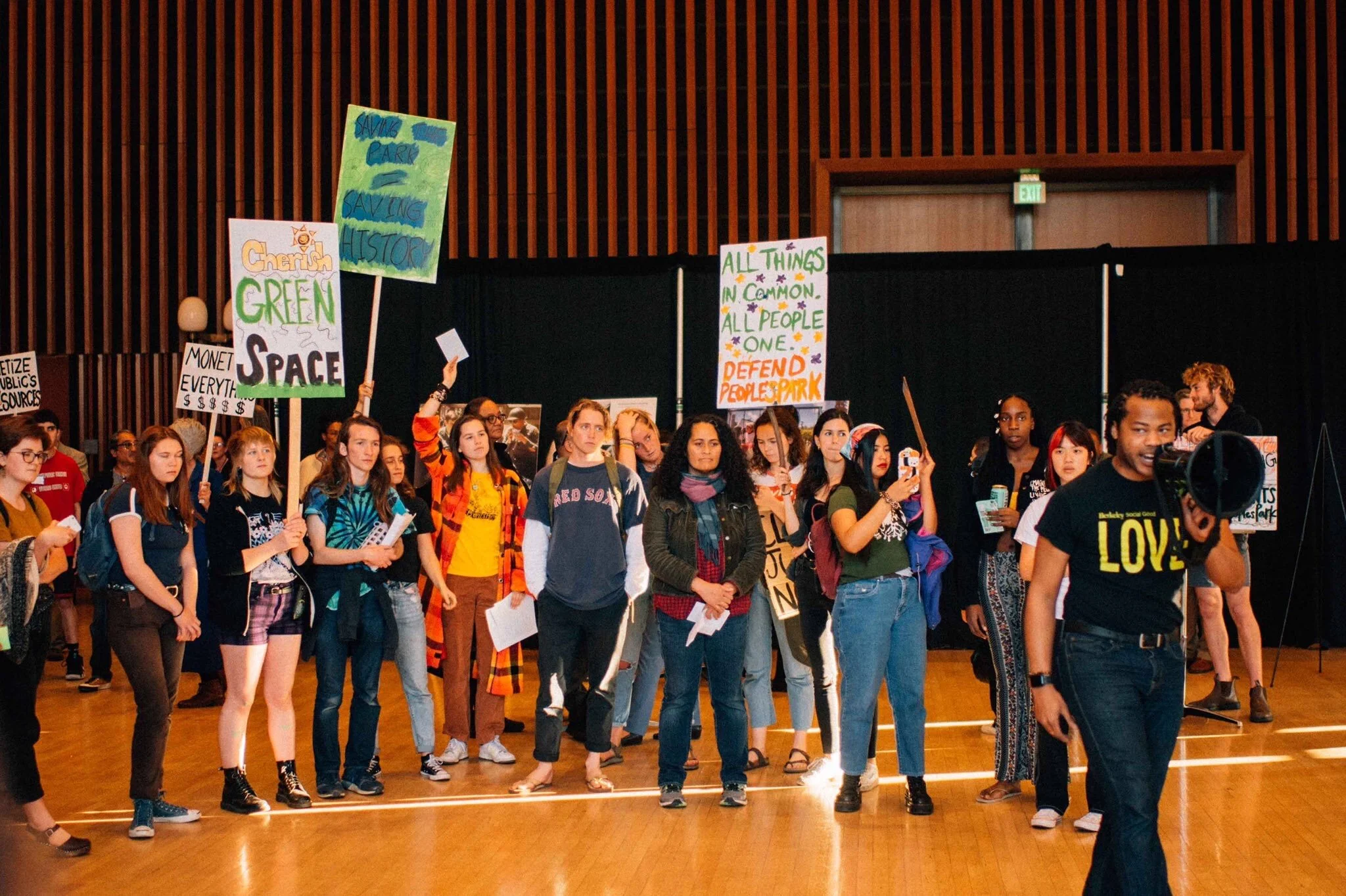
And none of this is hidden. Park supporters have written articles, spoken to newspapers, sent written communications, attended commission meetings, and commented at Council. The May 19 annotated agenda lists written communications on the Homekey+ item, the minutes record 21 speakers on the consent calendar, and the HAC minutes show public comment on the funding-reservation item.[22][45][47] UC and City decision makers may disagree with us. But they cannot credibly say they did not know that many people are tied emotionally, politically, and materially to People's Park, Telegraph, and Southside. When that knowledge does not change the process, the message people receive is simple: your attachment was known, and it was not treated as decision-making evidence.
That history should change the standard for process. A place built through community use, food, refuge, speech, and public opposition should not be folded into City funding actions as if the only question is whether the paperwork is ready.
The HAC minutes show two public speakers on the funding-reservation item, however, members of the People’s Park Community were shocked to find it was voted on without our knowledge. [22] At the next Housing Advisory Commission meeting, both myself and Joe Lisner both dissented and asked for them to bring the item back to the comission. The City Council minutes later show the extension adopted on the consent calendar as Resolution 72,124. That is a record of formal action. It is not the same as a real public process with the park's users, neighbors, gardeners, food sharers, disabled people, unhoused people, and Southside residents who have carried the consequences for years.[27][36]
The issue is not whether supportive housing is needed. It is. The issue is whether Southside residents are allowed to see the full chain of decisions linking UC development, City funding, commission votes, Council referrals, street design, road repair delays, and the candidates now asking to represent the district.
The point is not personal. The point is a pattern of public-space governance. Advertising kiosks, UC-led redevelopment, curbless street designs, private-vehicle restriction concepts, bus-lane corridors, and major Southside density have all been presented as modernization. But residents, small businesses, park users, disabled people, and neighborhood institutions are too often asked to respond after the basic direction has already been set.
People with power do not get to treat documented risks as background noise. When a plan creates foreseeable harm for small businesses, workers, disabled residents, pedestrians, cyclists, transit riders, and nearby residential streets, constituents have a right to demand accountability before the harm is locked in.
That is not enough.
Southside is not a sacrifice zone. It is home.
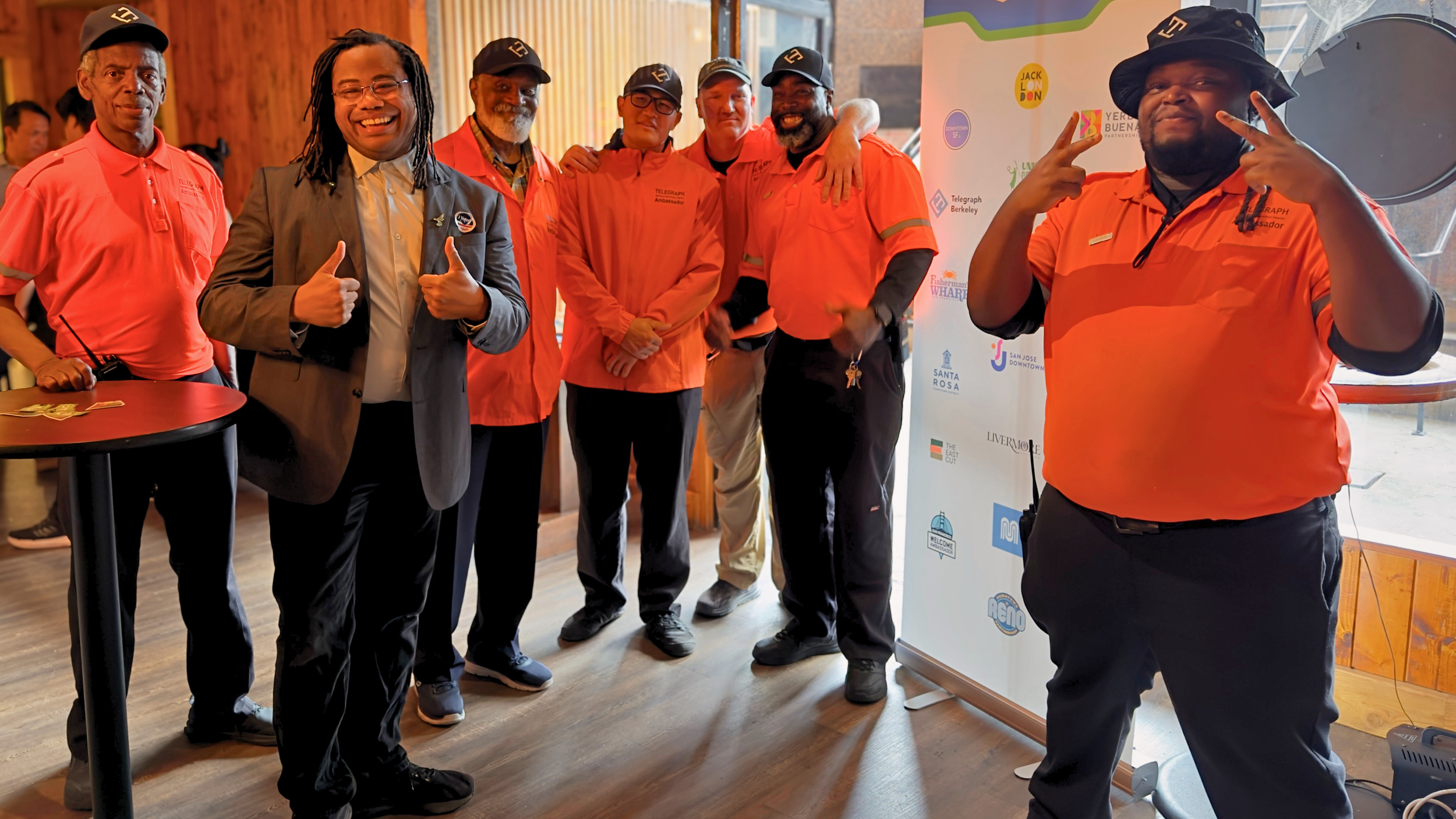
The People Who Keep Telegraph Working Matter
Campaign photo documentation shows Telegraph Ambassadors and corridor workers. They should be part of the process before street changes become final.[63]
Who Should Be Making These Decisions
The people most affected should have more than a comment period.
When people who will live with the consequences say a plan will hurt them, that should change the process. Opposition from affected people is not a nuisance. It is information the City has a responsibility to respect.
If a plan changes loading, deliveries, curb access, traffic circulation, bus movement, bike safety, disability access, and small business survival, then the people who live with those changes should be part of deciding the design before it is treated as the City's direction.
That is the democratic question underneath all of this: why should a small circle inside City process get to decide what happens to the rest of Southside?
That means small business owners and workers on Telegraph. It means people who labor in kitchens, work counters, close shops at night, make deliveries, clean storefronts, and depend on each shift to support a family. It means disabled residents and visitors. It means people on Bowditch, Dana, Ellsworth, Channing, Haste, Dwight, Bancroft, and College who will live with the traffic if the design fails.
It also means the City has to make the process usable. Not just one meeting. Not just a technical packet. Not just a final design with a comment box. Walk the blocks with the people affected. Show the turning movements. Show the loading plan. Show where deliveries go. Show how a bus, a bike, a wheelchair user, a trash truck, a fire engine, a delivery driver, and a closing-shift worker move through the same space.
If the City cannot explain that in plain language to the people most affected, then the design is not ready.
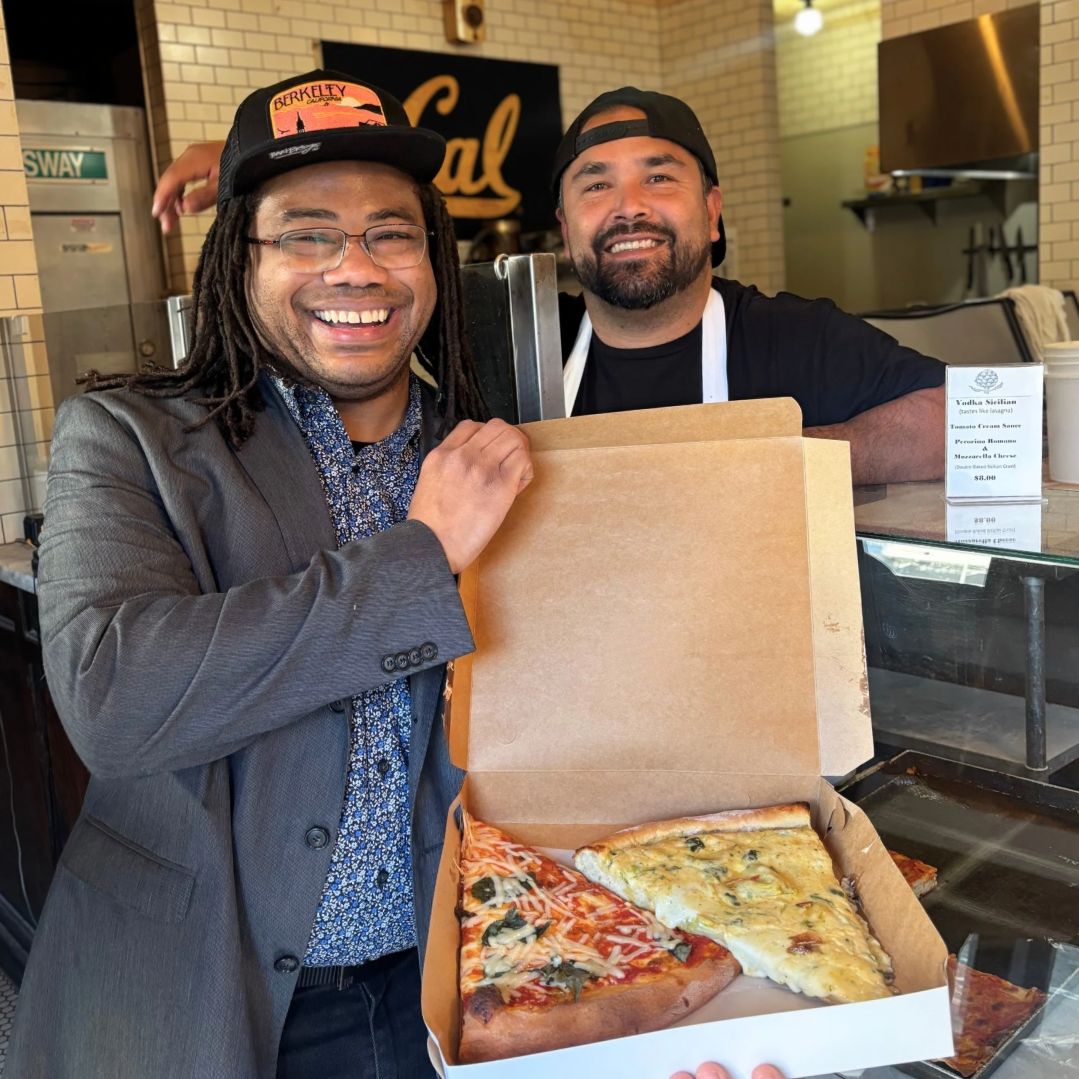
Small Businesses Need Daily Customers
Campaign photo documentation shows Artichoke Pizza serving customers. Multimodal planning should keep small businesses reachable, visible, and usable.[63]
That is why this election is about public process. Do people have a real say in how government affects them, or do a few people inside City process get to turn their own institutional ambition into everyone else's daily reality?
This is bigger than one street. It is about whether Southside is governed with the people who live and work here, or around them.
What Should Happen Instead
Berkeley should not move forward with a permanent redesign that restricts vehicle access or rearranges Telegraph's lanes until the City can answer the practical questions in public.
These are not just requests I am making from the outside. If elected, I will use my first 100 days to make them public work: Council referrals where needed, staff requests where needed, block walks with affected people, and a clear schedule for what the City will answer first.
The first standard is simple. Businesses and workers should be first at the table, not last.
Fix the street first. Telegraph should receive new pavement now. Bowditch repair should move into a public work plan, with visible progress on the pavement and safety problems residents already see. Safer streets should not wait for the completion of CAR FREE Telegraph planning.
Put access on paper before changing lanes. Before any permanent Telegraph lane configuration is approved, the City should publish a loading and delivery plan for small businesses, a disability and paratransit access plan, an emergency and refuse-collection plan, and a block-by-block explanation of how deliveries, buses, bikes, wheelchair users, pedestrians, workers, and limited vehicle access move through the same space. If the City wants plaza-style hours, it should say when those hours begin, when they end, and how access works during those periods.
Model the side streets honestly. The City should release a side-street traffic analysis for Bowditch, Dana, Ellsworth, Channing, Haste, Dwight, Bancroft, College, and nearby residential blocks. It should show how drivers would reach Durant, Channing, Haste, Bancroft, College, and Bowditch if Telegraph is restricted.
Study the better corridors. Telegraph should be studied as a multimodal civic street with timed plaza-style hours during peak pedestrian periods, not only as a permanent car-restriction project. Channing Avenue should be studied as the better bus-priority corridor before Telegraph is treated as the default bus-centered redesign. Bowditch should be studied as the car-free pedestrian-priority housing and bike corridor Southside is already becoming.
Make affected people decision makers. The City should hold a real public hearing focused on small businesses, small business workers, disabled users, residents, students, delivery workers, and nearby streets. It should publish a Durant after-action memo before using Durant as a model for Telegraph, and it should publish a Dwight and Telegraph access plan for residents and small businesses affected by current construction and any future restrictions.
Conclusion: Treat Telegraph As A Neighborhood
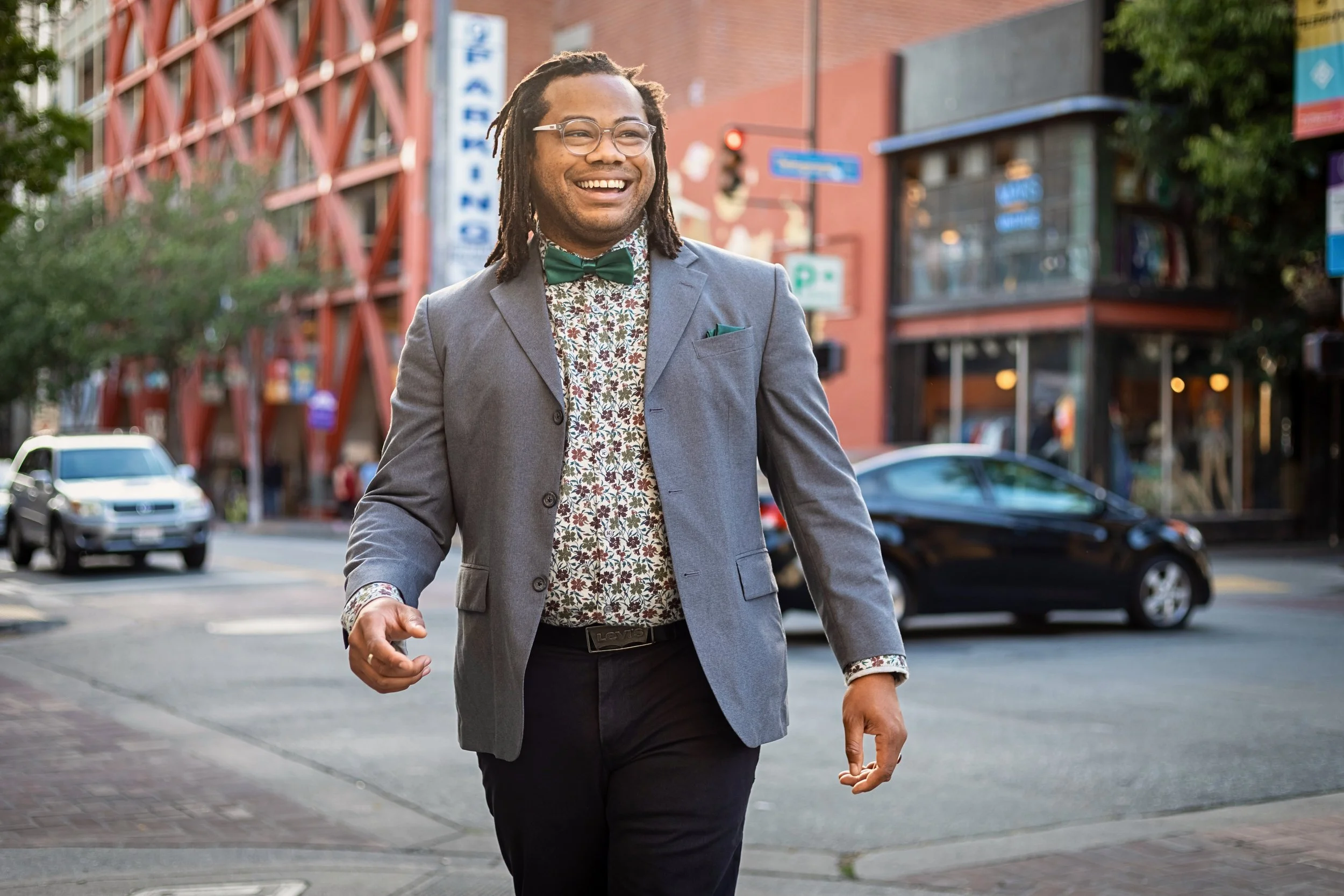
Treat Telegraph As A Neighborhood
Campaign photo documentation shows Aidan on Telegraph Avenue. The corridor needs repair, transit, bike access, sidewalks, small business access, and residential streets planned together.[66]
Telegraph does not need a false choice between unsafe streets and a permanent car-free design. It should remain multimodal. It needs repair now, not after the City finishes studying its preferred project. It needs buses that move, bikes that are protected, sidewalks that work, businesses that can receive deliveries, disabled access that is planned from the start, limited vehicle access that is managed honestly, and residential streets that are not treated as overflow capacity.
The record supports that concern. Berkeley's own materials show limited loading and operational problems for Telegraph small businesses, a fragile one-way circulation network, Durant delivery and bus-lane conflicts, and a street plan that deferred Telegraph because the future corridor configuration is unresolved. The photos and figures show the same problem at ground level: Bowditch needs repair, Durant is already constrained, Bancroft is already carrying mixed pressure, and Telegraph's commercial vacancy moved the wrong direction while the citywide rate improved.
That is why I do not support CAR FREE Telegraph as a permanent design. I support safer streets, bus lanes, bike lanes, and pedestrian space. I also support plaza-style hours when Telegraph's pedestrian use is highest. But transportation policy has to serve the people who live and work here, not force them to live around a concept that was decided inside City process before the operating details were answered.
My proposal is clear. Repair Telegraph now. Keep Telegraph multimodal. Manage it as a civic street with timed plaza-style hours during peak pedestrian periods, transit access, delivery windows, disabled access, emergency access, limited vehicle access, bike safety, pedestrian safety, and residential street protections. Study Channing as the bus-priority corridor. Make Bowditch the car-free pedestrian-priority corridor because that is where major housing, walking, and bike movement are already being concentrated.
This is also a public process issue. Small businesses, workers, disabled users, delivery workers, students, park users, and residents of Bowditch, Dana, Ellsworth, Channing, Haste, Dwight, Bancroft, College, and Telegraph should be at the table before the City treats a plan as settled. Under my Council leadership, Southside will be treated as a neighborhood, not a pass-through corridor or a planning exercise.
Southside is home.
Paid for by Aidan Hill for Berkeley City Council 2026, FPPC ID# 1481885.
Sources
[1] AC Transit history, public district established by voters in 1956: https://www.actransit.org/history
[2] AC Transit Board of Directors: https://www.actransit.org/board-of-directors
[3] City of Berkeley, Southside Complete Streets Project Conceptual Designs, February 22, 2022, staff report summary and current conditions: https://berkeleyca.gov/sites/default/files/2022-04/2022-02-22%20Item%2027%20Southside%20Complete%20Streets.pdf
[4] City of Berkeley, Southside Complete Streets Project Conceptual Designs, Telegraph Option 4 and car-free scope language: https://berkeleyca.gov/sites/default/files/2022-04/2022-02-22%20Item%2027%20Southside%20Complete%20Streets.pdf
[5] City of Berkeley, January 12, 2026 Agenda and Rules Committee packet, CAR FREE Telegraph item and Robinson supplemental material: https://berkeleyca.gov/sites/default/files/legislative-body-meeting-agendas/2026-01-12%20Agenda%20Packet%20-%20Agenda%20Committee.pdf
[6] City of Berkeley, Grant Applications: Alameda County Transportation Commission Comprehensive Investment Plan 2026, October 15, 2024: https://berkeleyca.gov/sites/default/files/documents/2024-10-15%20Item%2016%20Grant%20Applications%20%20Alameda%20County.pdf
[7] City of Berkeley, January 12, 2026 Agenda and Rules Committee packet, CAR FREE Telegraph budget referral: https://berkeleyca.gov/sites/default/files/legislative-body-meeting-agendas/2026-01-12%20Agenda%20Packet%20-%20Agenda%20Committee.pdf
[8] City of Berkeley, January 27, 2026 minutes for approval, CAR FREE Telegraph co-sponsors and approval action: https://berkeleyca.gov/sites/default/files/2026-02/2026-02-24%20Item%2001%20Minutes%20for%20Approval.pdf
[9] City of Berkeley, Five-Year Street Rehabilitation and Measure FF Plans, July 7, 2026, Telegraph deferral: https://berkeleyca.gov/sites/default/files/2026-07/2026-07-07%20Item%2010%20Five-Year%20Street%20Rehabilitation.pdf
[10] Oakland Department of Transportation, Telegraph Avenue Before/After Evaluation, 2021, Temescal traffic and speed findings: https://www.oaklandca.gov/files/assets/city/v/1/transportation/documents/projects/telegraph-avenue-corridor-improvements/2021-telegraph-kono-and-temescal-evaluation.pdf
[11] Oakland Department of Transportation, Telegraph Avenue Before/After Evaluation, 2021, pedestrian yielding findings: https://www.oaklandca.gov/files/assets/city/v/1/transportation/documents/projects/telegraph-avenue-corridor-improvements/2021-telegraph-kono-and-temescal-evaluation.pdf
[12] Oakland Department of Transportation, Upper Telegraph Design Decision Memo, August 1, 2024, road diet compared with bus-only lane design: https://www.oaklandca.gov/files/assets/city/v/1/transportation/documents/projects/upper-telegraph-avenue-complete-streets-project/24-0801-memo_upper-telegraph-design-decision.pdf
[13] Oakland Department of Transportation, Upper Telegraph Design Decision Memo, bus-lane implementation, safety, accessibility, and commercial loading concerns: https://www.oaklandca.gov/files/assets/city/v/1/transportation/documents/projects/upper-telegraph-avenue-complete-streets-project/24-0801-memo_upper-telegraph-design-decision.pdf
[14] City of Berkeley, Bicycle Boulevard Design Tools and Guidelines, Bowditch/Hillegass Bike Boulevard: https://berkeleyca.gov/sites/default/files/2022-02/Bicycle-Boulevard-Design-Tools-and-Guidelines.pdf
[15] UC Berkeley Capital Strategies, Channing-Bowditch Student Housing: https://capitalstrategies.berkeley.edu/channing-way-student-housing
[16] UC Berkeley, People's Park Housing, Student Housing: https://peoplesparkhousing.berkeley.edu/student-housing
[17] UC Berkeley Housing, Campus Housing: Upcoming Construction and Redevelopment Projects: https://housing.berkeley.edu/resources/campus-housing-upcoming-construction-and-redevelopment-projects/
[18] City of Berkeley, Southside Complete Streets Project Conceptual Designs, 2019 Robinson shared streets referral background: https://berkeleyca.gov/sites/default/files/2022-04/2022-02-22%20Item%2027%20Southside%20Complete%20Streets.pdf
[19] San Francisco Chronicle, "It's time for a new People's Park," by Rigel Robinson, Lori Droste, and Jesse Arreguin, February 3, 2020: https://www.sfchronicle.com/opinion/openforum/article/It-s-time-for-a-new-People-s-Park-15024231.php
[20] City of Berkeley minutes, December 13, 2022 Council meeting, IKE Smart City Kiosk Locations Phase Two: https://berkeleyca.gov/sites/default/files/documents/2023-01-17%20Item%2003%20Minutes%20for%20Approval.pdf
[21] City of Berkeley Commission Roster, July 2, 2026, Housing Advisory Commission listing for Syrak Micael and appointment by Councilmember Lunaparra: https://berkeleyca.gov/sites/default/files/documents/Commissioners_Roster_External.pdf
[22] City of Berkeley Housing Advisory Commission approved minutes, November 6, 2025, vote on Housing Trust Fund funding reservations including Supportive Housing in People's Park: https://berkeleyca.gov/sites/default/files/legislative-body-meeting-minutes/2025-11-06%20HAC_Approved%20Minutes.pdf
[23] Syrak Micael campaign website, Lunaparra endorsement and continuity statement: https://www.syrakforsouthside.com/
[24] City of Berkeley, Southside Plan, Southside one-way grid, circulation alternatives, Dana/Ellsworth, Bancroft/Durant, and traffic-volume evaluation criteria: https://berkeleyca.gov/sites/default/files/2022-03/Southside%20Plan.pdf
[25] City of Berkeley Office of Economic Development, 2025 Economic Dashboards, March 10, 2026, ground-floor commercial vacancy rates by district: https://berkeleyca.gov/sites/default/files/2026-03/2026-03-10%20Special%20Item%2001%20Berkeley%20Economic%20Dashboards.pdf
[26] National Register of Historic Places Registration Form for People's Park, community garden, Council Grove, refuge, free meals, and Black Panthers free food program context: https://ohp.parks.ca.gov/pages/1067/files/CA_Alameda_Peoples%20Park_DRAFT.pdf
[27] City of Berkeley minutes, February 10, 2026 regular meeting, Lunaparra present, consent-calendar vote recorded as all ayes, and adoption of Resolution 72,124 extending Housing Trust Fund reservations: https://berkeleyca.gov/sites/default/files/2026-03/2026-03-24%20Item%2003%20Minutes%20for%20Approval.pdf
[28] City of Berkeley, Budget Referral: Durant Parklet and Telegraph Plaza Improvements, October 26, 2021, DoorDash/UberEats, pandemic takeout, and Durant congestion: https://berkeleyca.gov/sites/default/files/documents/2021-10-26%20Item%2030%20Budget%20Referral%20%20Durant%20Parklet%20and%20Telegraph%20Plaza%20Improvements.pdf
[29] City of Berkeley, Authorize a Funding Agreement with AC Transit to Supplement the Quick-Build Durant Transit Lane Project, February 14, 2023, heavy loading traffic, delivery double parking, transit reliability, and Durant as access corridor: https://berkeleyca.gov/sites/default/files/documents/2023-02-14%20Item%2010%20Authorize%20a%20Funding%20Agreement.pdf
[30] City of Berkeley, Durant Avenue Curb Management Strategy, bus-only lane conflicts, double parking, and short-term/commercial loading changes: https://berkeleyca.gov/your-government/our-work/capital-projects/durant-avenue-curb-management-strategy
[31] AC Transit, Durant Avenue Project, project scope and June 2025 operational status: https://www.actransit.org/quick-builds/durant-ave
[32] City of Berkeley, City Council Special Meeting eAgenda, February 23, 2026, 2425 Durant Avenue use permit appeal and project description: https://berkeleyca.gov/city-council-special-meeting-eagenda-february-23-2026
[33] Aidan Hill campaign photo documentation of Bowditch bike lane visible cracking.
[34] City of Berkeley, May 7, 2024 Council item confirming the April 16, 2024 Special Municipal Election results for District 7, Robinson vacancy, Lunaparra election, and certified vote totals: https://berkeleyca.gov/sites/default/files/documents/2024-05-07%20Special%20Item%2001%20Confirming%20the%20Results%20of%20the%20April.pdf
[35] City of Berkeley Commission Roster, April 15, 2024, Environment and Climate Commission listing for Cecilia Lunaparra as District 7 appointee by Robinson, term start June 21, 2022: https://berkeleyca.gov/sites/default/files/documents/External%20Roster%2004-15.pdf
[36] Aidan Hill firsthand account of the November 6, 2025 Housing Advisory Commission item: Aidan Hill and Joe Lisner were the two public speakers on the Supportive Housing in People's Park funding-reservation item, and both dissented. The approved minutes record two public speakers but do not identify them by name.
[37] City of Berkeley, Interactive Kiosk Experience (IKE) Smart City Kiosk Locations, Phase Two, December 13, 2022, staff report and approved Phase Two locations: https://berkeleyca.gov/sites/default/files/documents/2022-12-13%20Item%2008%20Interactive%20Kiosk%20Experience.pdf
[38] City of Berkeley minutes, October 15, 2019 regular meeting, Phase One IKE approval and direction for amended agreement on third-party data sharing and privacy protection: https://berkeleyca.gov/sites/default/files/documents/2019-11-19%20Item%2001%20Minutes%20for%20Approval.pdf
[39] IKE Smart City, Privacy Policy for Berkeley, August 30, 2022, Wi-Fi MAC address language, identifiers, usage data, geolocation data, and third-party disclosures: https://www.ikesmartcity.com/documents/en/privacy-policy-berkeley.html
[40] Berkeley News, "New Gateway building creates dedicated campus hub for AI, computing," May 13, 2026: https://news.berkeley.edu/2026/05/13/new-gateway-building-creates-dedicated-campus-hub-for-ai-computing/
[41] Berkeley Inspire, "A new way to educate, discover, and accelerate impact," Gateway size, role, and $252 million lead gift: https://inspire.berkeley.edu/o/the-gateway/
[42] UC Berkeley Parking and Transportation, Campus Parking Map, August 2025, listing campus parking lots and garages including Underhill Garage, Unit I Lot, Unit II Lot, Dwight Way Lot, Ellsworth Structure, Lower Sproul Garage, and RSF Garage: https://pt.berkeley.edu/sites/default/files/campus_parking_map_august_2025.pdf
[43] California CEQAnet, Cal Beach Volleyball Complex Project, University of California Berkeley lead agency, Oxford Street and Bancroft Way cross streets, and project description replacing an existing parking lot with a five-court sand volleyball facility: https://ceqanet.lci.ca.gov/2025010536/2
[44] Supreme Court of California, Make UC a Good Neighbor v. Regents of the University of California, S279242, June 6, 2024, Court of Appeal alternative-locations holding and Assembly Bill 1307 effect: https://www.courts.ca.gov/opinions/archive/S279242.PDF
[45] City of Berkeley minutes, May 19, 2026 regular meeting, consent-calendar public comment, all-ayes consent vote, and Item 6 adoption as Resolution Nos. 72,273 and 72,274: https://berkeleyca.gov/sites/default/files/2026-06/2026-06-30%20Item%2018%20Minutes%20for%20Approval.pdf
[46] City of Berkeley, Joint Homekey+ Application for Supportive Housing in People's Park at 2556 Haste St., May 19, 2026 staff report, Homekey+ application, 110 units, $14,359,593 Housing Trust Fund reservation, and $35 million maximum Homekey+ application amount: https://berkeleyca.gov/sites/default/files/2026-05/2026-05-19%20Item%2006%20Joint%20Homekey%2B%20Application.pdf
[47] City of Berkeley, May 19, 2026 annotated agenda, written communications on Item 6, Joint Homekey+ Application for Supportive Housing in People's Park: https://berkeleyca.gov/sites/default/files/city-council-meetings/2026-05-19%20Annotated%20Agenda%20-%20Council.pdf
[48] California CEQAnet, 2449 Dwight Way - ZP2022-0021, City of Berkeley public agency, Dwight Way and Telegraph Avenue cross streets, eight-story mixed-use project with 63 dwelling units and commercial floor area: https://ceqanet.lci.ca.gov/2026030661
[49] El Trompudo official online ordering page, Berkeley location at 2441 Dwight Way: https://www.eltrompudotacos.com/s/order
[50] Richmondside, May restaurant openings roundup, reporting El Trompudo opened at 2441 Dwight Way in late May 2026: https://richmondside.org/2026/06/08/teni-east-sightglass-dave-busters-ramen-openings/
[51] Aidan Hill firsthand account and campaign photo documentation of construction-related traffic, curb restrictions, and direct street access disruption near El Trompudo at Dwight and Telegraph.
[52] IKE Smart City general Privacy Policy, environmental sensors, camera footage, facial-recognition disclaimer, and biometric information limited to a user's face captured on the kiosk camera when activated by the user: https://www.ikesmartcity.com/documents/en/privacy-policy.html
[53] Aidan Hill campaign photo documentation of Bancroft Way construction pressure, including construction equipment, tow-away signage, crosswalk closure signage, and storefront access constraints.
[54] Aidan Hill campaign photo documentation of Durant Avenue night construction, lane controls, and narrowed usable street space.
[55] Aidan Hill campaign photo documentation of a Telegraph storefront with a "Store Closing, Everything Half Off" sign.
[56] Aidan Hill campaign photo documentation of sidewalk closure fencing and storefront access constraints near Moe's Books on Telegraph.
[57] Aidan Hill campaign photo documentation of Haste and Telegraph street conditions, including visible pavement and sidewalk wear.
[58] Cal Alumni Association, "The Push to Abolish Cars on Telegraph," December 1, 2022, Robinson and Telegraph for People advocacy, Robinson quote, Option Five context, and Moe's Books / Telegraph Business Improvement District concerns: https://alumni.berkeley.edu/california-magazine/2022-winter/the-push-to-abolish-cars-on-telegraph/
[59] The Daily Californian, "Students revive decades-old fight for a car-free Telegraph," March 10, 2023, Telegraph for People as student-led organization, Lunaparra as member, Option Five, and business concerns: https://data.dailycal.org/2023-03-10-telegraph-pedestrianized/
[60] City of Berkeley, "Southside: Now safer and easier to walk, bike, take transit," September 29, 2025, Bancroft Way protected bikeways and dedicated bus-only lanes on Bancroft and Durant: https://berkeleyca.gov/community-recreation/news/southside-now-safer-and-easier-walk-bike-take-transit
[61] Aidan Hill campaign photo documentation of Southside construction equipment, sidewalk barriers, curb constraints, and pedestrian access pressure around Telegraph-area blocks.
[62] Aidan Hill campaign photo documentation of an IKE Smart City kiosk in Berkeley public space near the Telegraph and Southside corridor.
[63] Aidan Hill campaign photo documentation of Telegraph storefronts, local small businesses, workers, customers, and campaign visits.
[64] Aidan Hill campaign photo documentation of People's Park before the construction footprint, including aerial and ground-level public-use images.
[65] Aidan Hill campaign photo documentation of blocked bicycle infrastructure access in Southside construction conditions.
[66] Aidan Hill campaign photo documentation of Telegraph Avenue and neighborhood campaign images, including Aidan on Telegraph Avenue.