SF Mime Troupe at Live Oak Park: Why Public Culture Matters
On Saturday, July 18, the San Francisco Mime Troupe turned a part of Live Oak Park into a theater.
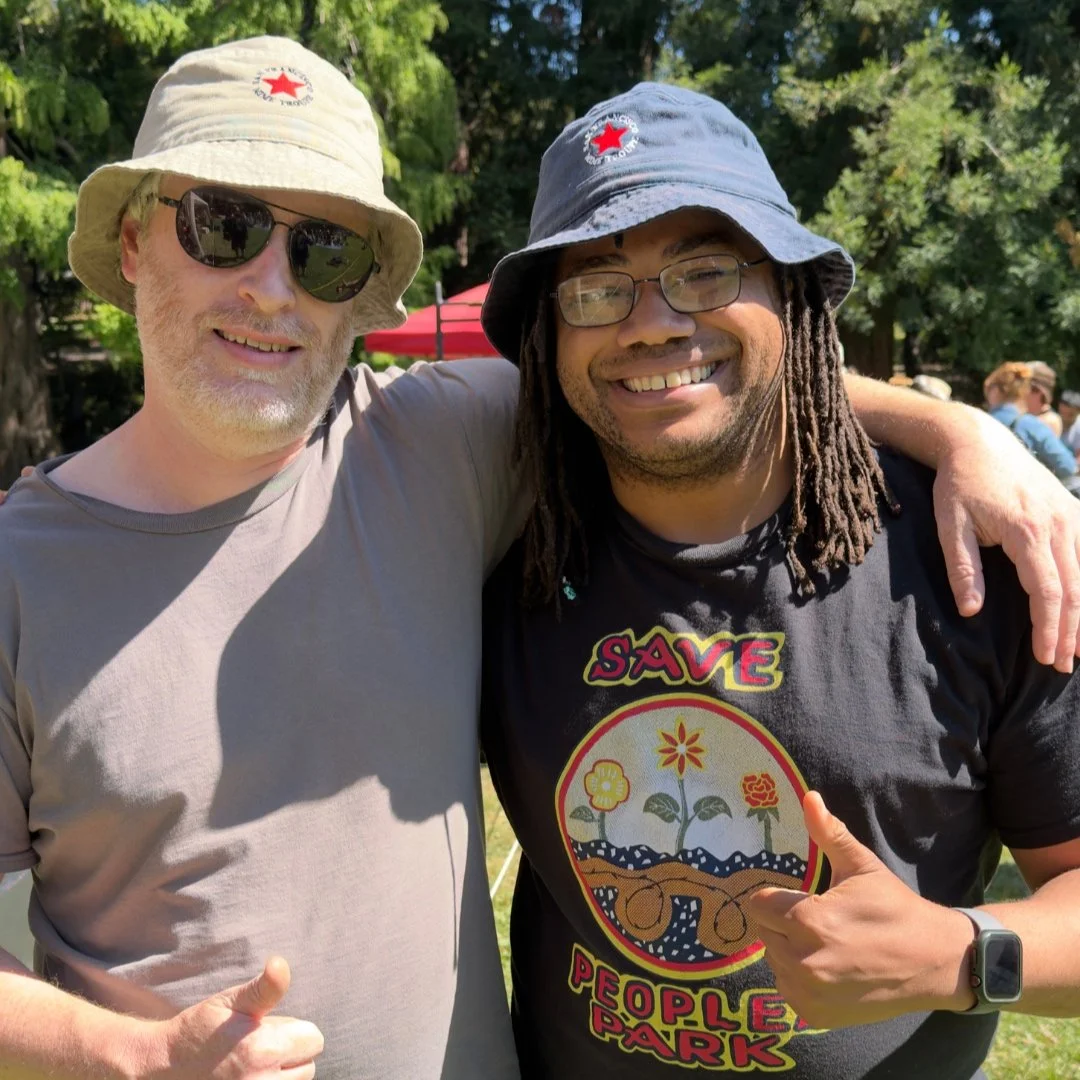
A Saturday at Live Oak Park. Aidan Hill with composer Daniel Savio before the San Francisco Mime Troupe's July 18 performance. The official schedule lists Berkeley shows at the park on July 18 and 19, 2026.
A band played. Four actors moved between artificial intelligence, unaffordable housing, religious certainty, immigration, and the use of state power. People could walk in from the sidewalk, sit under the trees, and watch without buying a ticket.
I was wearing a Save People's Park shirt, and the connection felt immediate. Public culture needs public space.
WRECKAGE Makes Large Problems Feel Close
WRECKAGE: A Musical Tragicomedy is the San Francisco Mime Troupe's 67th-season production. The show asks how people survive and rebuild after economic, social, and psychological damage. It runs in Bay Area parks and theaters from July 3 through September 7, 2026. [1]
The story follows Mari, a flower seller trying to hold onto her place in an increasingly unaffordable city. Bobby is a software developer who learns that the artificial-intelligence product his company wants to sell is not actually intelligent. Lance joins the National Guard while pursuing citizenship, then finds himself facing protesters exercising the freedoms he meant to defend. [1]
The characters are fictional, but the pressure around them is familiar: rising rents, employers that reward silence, technology companies selling certainty they have not earned, and government power reaching ordinary people long before they get a meaningful say.
The show is political, but it is also funny, musical, and willing to let its characters be complicated. The jokes do not make the problems smaller. They give the audience a way to stay with them.
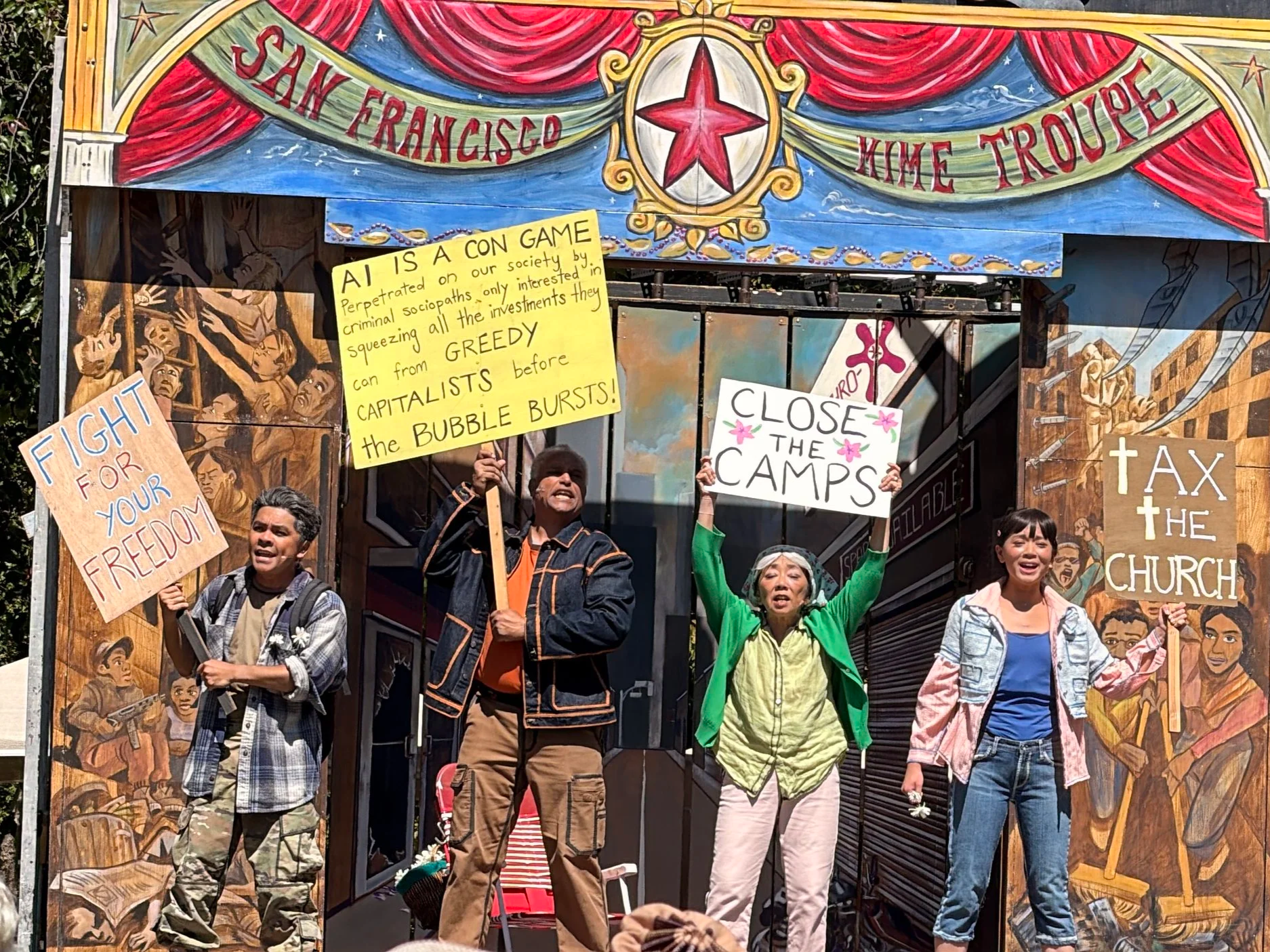
WRECKAGE in Berkeley. The cast performs on the Troupe's outdoor stage at Live Oak Park. The production was written by Michael Gene Sullivan, with music and lyrics by Daniel Savio, and directed by Lisa Hori-Garcia.
A Park Can Become a Town Square
The Troupe says its mission is to bring a working-class analysis of social and economic injustice to the broadest possible audience through artistry and humor. It is run by a worker-owned collective, and its summer park performances are generally free, with donations invited from people who can give. [2], [4]
That model depends on more than artistic talent. It depends on land people can enter without buying something. It depends on maintained paths, usable restrooms, shade, transit access, and permits that allow community art to happen.
This is why public culture belongs in conversations about infrastructure. A city supports democratic life through more than meeting rooms and Council agendas. It also maintains the places where strangers can gather, disagree, laugh, rest, and encounter something they did not plan to see.
Free admission does not mean the work costs nothing. Artists, stage crews, musicians, and production workers still need to be paid. The San Francisco Mime Troupe is direct about that reality and asks audiences to help keep the performances accessible. [4]
What Live Oak Park Makes Visible
Live Oak Park and People’s Park are not interchangeable. Their histories, users, and present conditions are different. But this performance made one fact visible: when public space is open and usable, people make culture together.
From my years organizing at People’s Park, I remember people cooking food, playing music, tending plants, resting, arguing, and building relationships without needing to make a purchase. The loss of that access is not only about acreage on a map. It is about what people are allowed to do together.
As a Southside resident and longtime People’s Park organizer, that is why I treat public space as civic infrastructure. It affects who can participate in city life, whose history remains visible, and whether gathering in public survives as Berkeley grows.
What Berkeley Should Do
Berkeley should maintain the public spaces it already has before neglect becomes a crisis. A park cannot serve the public if its restrooms are closed, its paths are inaccessible, its lighting is poor, or basic upkeep is allowed to fail.
The City should also make free community arts easier to produce. Permit rules should be clear. Timelines should be predictable. Public support should help pay artists and workers while keeping events open to people who cannot afford a ticket.
When the future of public land is being decided, the people who use that place should be involved early enough to change the result. Public comment after a direction is effectively settled is not meaningful participation.
As a councilmember, I would treat this as connected work. I would press for maintenance funding before conditions become emergencies and support accessible cultural events. Before a vote on major changes to public space, I would propose that the Council require a published analysis of the alternatives, costs, maintenance needs, and effects on current users.
See WRECKAGE in Berkeley
The Live Oak Park performances were not the Troupe’s last Berkeley stops this summer. The official schedule lists shows at Willard Park on August 22 and 23 and Cedar Rose Park on August 29 and 30. Music begins at 1:30 p.m., and the performances begin at 2:00 p.m. Admission is free, with a $20 suggested donation. Check the official schedule before attending in case details change. [3]
Go see the show.
The Troupe’s free run depends on audience support, and the park itself shows what public land makes possible.
Berkeley should not wait for wreckage to remember why common spaces matter.
-
San Francisco Mime Troupe, 2026 press information for WRECKAGE: A Musical Tragicomedy: https://www.sfmt.org/press-wreckage
San Francisco Mime Troupe, About Us and mission: https://www.sfmt.org/about-us
San Francisco Mime Troupe, 2026 schedule by date: https://www.sfmt.org/press-schedule-by-dates
San Francisco Mime Troupe, The Cost of Free: https://www.sfmt.org/cost-of-free-appeal