

City Services
Services People Can Rely On

City Services People Can Rely On
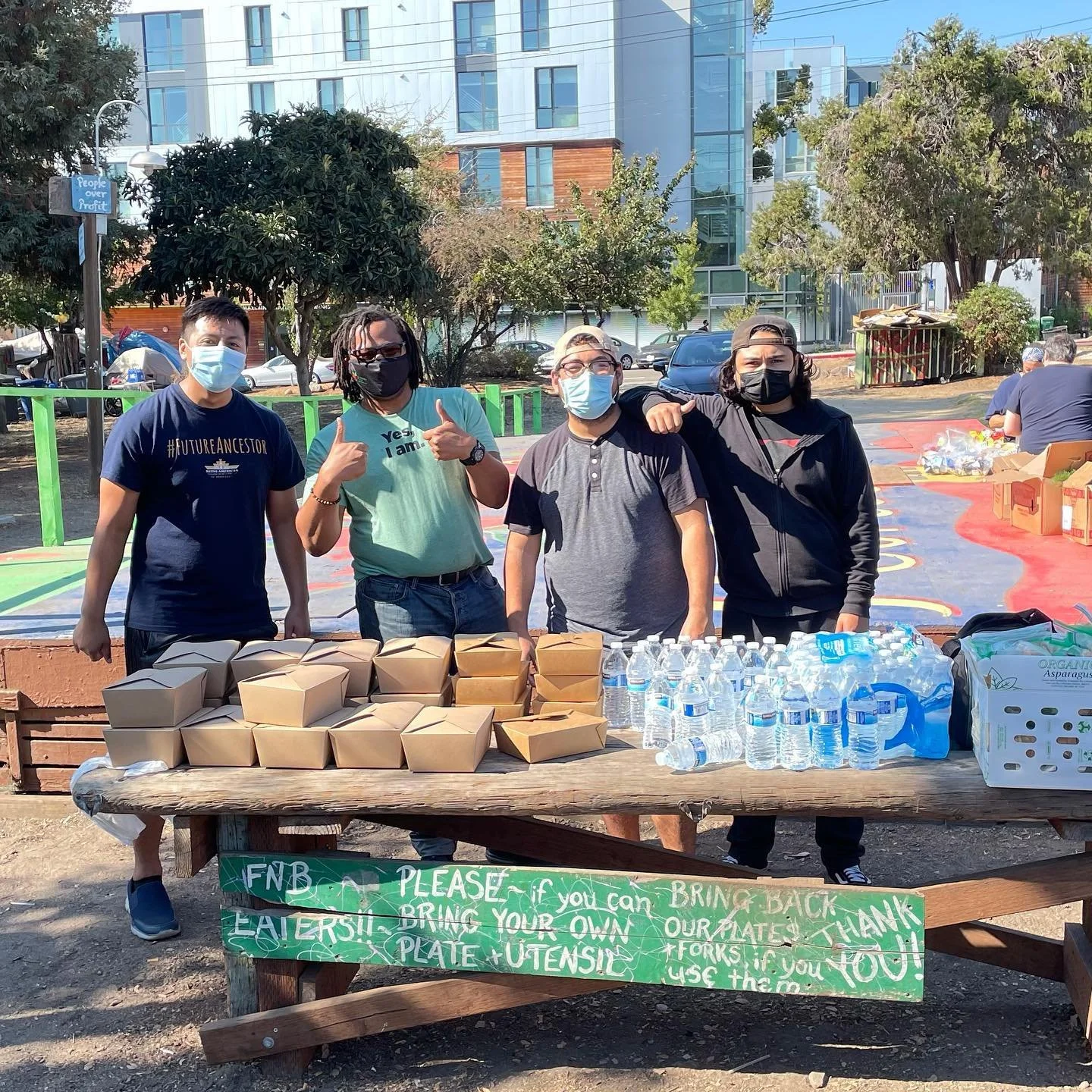
I have lived in Southside since 2016 and organized here since 2017. Work with People's Park and East Bay Food Not Bombs has kept me involved in the everyday needs of this neighborhood. Whether someone has a clear sidewalk, a working streetlight, a place for unwanted furniture, or a dependable response when something goes wrong affects what they can do with the rest of their day.
As a medical health worker, I help people navigate services that can be difficult to reach and coordinate. Giving someone a phone number does not necessarily resolve their need. The work involves understanding the problem, connecting the appropriate services, and following up. I want City government to bring that same discipline to the conditions residents depend on.
Maintenance is governance. Berkeley should repair existing problems, prepare for predictable demand, and make services keep pace with neighborhood growth. Every commitment should identify who is responsible, how the work will be funded, what happens next, and how residents will know whether it was completed.
-
Berkeley has programs for service requests, sidewalk repair, street improvements, shared mobility, seasonal waste, crisis response, and emergency preparation. These programs address different conditions and are controlled by different departments, institutions, contractors, and funding sources. Understanding their limits means examining what they accomplish, how their responsibilities connect, and which problems remain unresolved.
A Service Request Does Not Guarantee Resolution
Berkeley’s Information Technology Department describes the 311 Customer Service Call Center as a first point of contact that provides information and collects service-related data on behalf of the City.
That intake function is necessary. Resolving a request may still require an inspection, referral to another department, action by a property owner or contractor, or funding for permanent work.
Recording a problem and resolving the condition are separate stages. A complete assessment should examine the time between intake, inspection, temporary protection, permanent repair, and closure. It should also identify repeat requests at the same location and cases closed without verification that the physical condition changed.
Individual Repairs Do Not Create a Complete Accessible Route
Berkeley’s sidewalk-repair program assigns responsibility for adjacent sidewalks to property owners. The City can install a temporary “make-safe” measure and offers an approved 50-50 cost-sharing program. Approved applicants are placed on a waitlist, and the City states that make-safe work is not a permanent repair.
The Southside Complete Streets project was completed in August 2025. It added bicycle facilities, bus lanes, crossing improvements, traffic-signal changes, and selected accessible curb ramps on Bancroft Way, Dana Street, and Fulton Street.
These programs provide documented improvements. They address individual locations and defined project areas.
An accessible journey depends on the entire route. A repaired sidewalk can lead to a blocked curb ramp, inaccessible crossing, unsafe construction detour, damaged surface, or another obstruction. Evaluation should therefore examine complete practical routes, the remaining barriers along them, the responsible parties, and the schedule for each correction.
Scooter-Parking Rules Depend on Compliance and Enforcement
Berkeley’s shared-bike and scooter rules require scooters to be parked upright, locked to an appropriate fixed object, and placed near the curb, at a bicycle rack, or in a designated parking zone. Scooters may not block sidewalks, doorways, driveways, accessible paths, bus stops, or streets. The City instructs users to leave at least four feet of clear pedestrian space.
Scooter operators must monitor parking compliance, respond to complaints within required time limits, support designated parking zones, and submit quarterly reports. The City may impose fines, fleet reductions, permit suspension, or other administrative penalties.
Those requirements establish a regulatory system. The published rules do not, by themselves, show whether recurring Southside obstruction locations remain clear.
The relevant measure is whether the pedestrian path becomes and stays usable. Evaluation should include complaints, clearance times, repeat locations, parking zones installed, unresolved violations, operator penalties, and whether additional infrastructure or permit conditions are needed.
Seasonal Programs Need Current Operating Plans
Cal Move-Out was created in 2007 to coordinate City and UC resources and reduce the environmental and neighborhood effects of illegal dumping near campus. The program has combined student and property-owner outreach, reuse services, disposal information, and deployment of debris bins.
The published page still prominently describes 2024 dates, locations, eligibility rules, and operating arrangements. That information documents how the program has worked, but it does not establish the current plan for the next move-in or move-out period.
Furniture collection is also only one part of the operating problem. Moving vehicles, loading, scooters, waste containers, deliveries, construction activity, and ordinary traffic may compete for the same sidewalk and curb space.
Predictable demand should produce a current operating plan. Residents should be able to find the dates, collection locations, accepted items, loading arrangements, accessible-route protections, participating institutions, enforcement responsibilities, and costs before each major cycle. Reporting afterward should show participation, collected material, blocked routes, repeat dumping locations, complaints, and actual expenses.
A Referral Does Not Guarantee a Completed Connection to Care
Berkeley’s Crisis Services page directs people experiencing a mental-health or substance-use crisis to 988. For an in-person wellness check or psychiatric evaluation, residents can call Berkeley Police and request Alameda County’s Crisis Assessment and Transport Team.
The City states that it does not manage the County team and that availability and response times vary.
UC Berkeley separately provides students with Counseling and Psychological Services, same-day counseling, specialized resources, off-campus referrals, and an after-hours support line. Those services have their own eligibility, operating hours, and institutional responsibilities.
Community organizations may provide food, peer support, trusted relationships, and help navigating services. They perform an important function, but they cannot replace professional care or public responsibility.
Giving someone a number or referral does not establish that appropriate help was received. Evaluation should examine response availability, completed handoffs, connections to continuing care, repeat needs, service gaps, and complaints. Personal health information must remain protected.
Training Does Not by Itself Create Neighborhood Readiness
Berkeley offers disaster-preparedness training, including Berkeley Ready and Community Emergency Response Team instruction. The City and UC also operate separate emergency-notification systems serving overlapping populations.
Training and alerts create useful capacity. Southside still has dense buildings, frequent resident turnover, students arriving from outside the region, disability-access needs, multilingual communication needs, and responsibilities divided among the City, UC, property owners, cooperatives, businesses, and residents.
A training course does not establish whether a particular building has current information, whether a resident knows which alert system to use, or whether an accessible evacuation plan has been tested.
Preparedness should be measured through delivery and correction. Relevant evidence includes participation, building coverage, accessible and multilingual materials, recurring exercises, communication failures identified during those exercises, assigned corrections, and whether the corrections were completed.
Evaluating the Whole System
City services should be assessed through access, ownership, response, continuity, funding, maintenance, and outcomes. Existing programs have documented benefits, defined responsibilities, and specific boundaries. A clear public assessment must acknowledge those achievements while showing which conditions remain unresolved, where responsibility changes, and what resources or decisions are needed to produce a lasting result.
-
These Proposals Predate This Election
The proposals to change Telegraph Avenue and improve the Dwight Triangle are continuations of longstanding City work.
Berkeley’s Southside Plan, adopted in 2011, called for safer crossings, improved lighting, streetscape amenities, and additional activity around the Dwight and Telegraph triangle. A 2016 public-realm plan identified the Triangle as a priority. Former Councilmember Rigel Robinson then advanced related referrals in 2019, 2021, and 2023.
The City allocated $100,000 in 2020 toward rehabilitating the Triangle. A 2021 referral sought another $60,000 for a Durant parklet and a Dwight Triangle plaza. A 2023 referral sought to open the space, install seating and chess tables, and refer $25,000 for improvements. Councilmember Cecilia Lunaparra followed with a 2024 resolution concerning public use of the Triangle.
Commissioner Micael’s current platform supports transitioning Telegraph into a car-free street and revitalizing the Dwight Triangle. Those positions continue a policy direction developed through earlier plans and two successive District 7 council offices. The current campaign page does not identify how its proposals change the scope, financing, or operating structure of those earlier efforts.
Longstanding proposals can still be worth completing. Their history means residents should be able to compare what each candidate would change, which unfinished decisions they would resolve, and how their approach would move beyond the prior referrals.
The Telegraph Proposals Differ in Their Basic Direction
Commissioner Micael’s published platform supports a transition to a car-free Telegraph to improve pedestrian safety, support businesses, and create additional gathering space. The page does not identify the affected blocks, implementation schedule, pilot structure, operating hours, or conditions under which private vehicles would retain access.
Aidan Hill’s published position opposes making Telegraph permanently car-free. It proposes keeping Telegraph multimodal, allowing timed plaza-style hours during periods of heavy pedestrian use, improving Bowditch as a pedestrian-priority corridor, and studying Channing as an alternative bus-priority corridor.
These positions lead to different planning questions. A permanent restriction requires a complete operating model for transit, paratransit, deliveries, loading, emergency access, refuse collection, bicycles, construction, and displaced traffic. A timed model requires enforceable hours, clear access rules, movable controls, staffing, and coordination among the City, AC Transit, businesses, and emergency services.
Car-Free Telegraph Is a Major Capital Proposal
The City’s current planning record provides a clearer indication of the potential cost than the campaign platforms alone.
The City’s CAR FREE Telegraph referral sought $1.325 million for feasibility work, environmental and traffic review, outreach, and preliminary design. The same document estimated:
$350,000 to $500,000 for feasibility, environmental review, traffic analysis, and utility investigation
$125,000 to $175,000 for public outreach
$480,000 to $650,000 for preliminary design
$600,000 to $700,000 for final design
$12 million to $17 million for construction and implementation
The $1.325 million referral covered only the first three categories. It was not a complete construction budget. The document anticipated seeking county, state, or federal transportation funding for later phases.
Commissioner Micael’s platform does not say whether he supports this precise scope, these cost ranges, or a different implementation plan. It also does not identify recurring costs for cleaning, programming, enforcement, maintenance, or traffic management after construction.
The financial comparison should therefore distinguish study money, final design, construction, and ongoing operations. Each requires a separate decision and may depend on a different funding source.
The Dwight Triangle Has Reached an Implementation Question
Commissioner Micael’s platform calls for revitalizing the Dwight Triangle as a community gathering space. The published page does not specify whether that means opening the existing enclosed area, permanently closing the slip lane, constructing the larger plaza previously proposed, or completing those steps in phases.
Those alternatives have different requirements. Opening the existing space would still require decisions about accessibility, hours, sanitation, seating, landscaping, programming, maintenance, and responsibility for daily conditions. Closing the slip lane would also affect the Route 6 bus, fire access, large-vehicle turns, circulation, engineering, and construction costs. Those transportation questions were already identified in the City’s 2021 Dwight Triangle proposal.
A current proposal should identify which phase it seeks, what earlier appropriations accomplished, which department owns the next decision, and what additional funding remains necessary. That would allow residents to distinguish a near-term opening from a complete reconstruction of the intersection.
Construction Access Requires an Enforceable Standard
Commissioner Micael’s platform says pedestrian and bicycle mobility should be protected during construction. It does not identify a responsible department, required clearance standards, inspection process, enforcement mechanism, or responsibility for costs.
The alternative published by Hill proposes a standard checklist for major projects covering accessible detours, loading, waste collection, lighting, drainage, emergency access, and post-construction service demand. It also calls for identifying which costs belong to a project sponsor and which require a separate public appropriation.
The practical distinction is whether construction access remains a general project goal or becomes a condition with an assigned owner, inspection process, correction deadline, and consequence for noncompliance.
Community Care Requires Capacity Beyond an Office Hour
Commissioner Micael proposes weekly office hours and expanded relationships with community and campus partners to connect residents and students with food, primary-care referrals, mental-health resources, and essential services. The published page does not identify participating providers, referral responsibilities, privacy practices, follow-up procedures, service capacity, or funding.
Office hours can help people identify a need and find an initial contact. They do not increase the number of appointments, food distributions, crisis responders, or other services available when existing providers are full.
The City also has a role that extends beyond referrals. It can convene public agencies and community organizations, identify coverage gaps, fund eligible work, establish service agreements, and report whether a referral produced a completed connection. Community organizations, student groups, mutual-aid networks, health providers, and neighborhood institutions provide relationships and continuity that City government cannot create by itself.
A complete proposal should define both parts: what the City is responsible for providing or coordinating, and what community care networks need in order to remain durable, accessible, and accountable to the people they serve.
Residents Need the Full Implementation Record
The published proposals can be compared through several basic questions:
What specific action would the Council be asked to take?
Which blocks, facilities, or services would be affected?
Which City department or outside institution is responsible?
What has already been studied, referred, or funded?
What would planning, construction, and recurring operations cost?
How would transit, disability access, deliveries, emergency response, and nearby streets be protected?
What could begin within 100 days, and what would require later approval?
What result would be reported publicly?
District 7 has already spent years seeing these ideas described, studied, referred, funded in part, and carried from one council office to the next. The remaining public question is how each current proposal defines its scope, responsible institution, funding plan, operating model, schedule, and measurable result.
-
My first 100 days will focus on initiating the processes needed to carry out this City Services platform. These are requests I will advance; adoption, funding, staffing, and implementation require further public decisions and coordination with City departments, Alameda County, UC Berkeley, and community organizations.
Establish service ownership and resolution standards. Request a District 7 service baseline covering open requests, repeat locations, response times, and departmental responsibility. Seek reporting that distinguishes an initial response, temporary protection, referral, and completed repair.
Begin the complete-route and street-operations review. Request a coordinated assessment of sidewalks, crossings, curb ramps, lighting, drainage, construction access, loading conditions, and shared scooters blocking pedestrian and disability access. Use the findings to identify priority routes and develop an annual Southside operations plan for move-in, move-out, waste collection, traffic conditions, and predictable sidewalk blockages.
Convene the Southside community-care network. Bring City and County services together with community organizations, health providers, campus programs, student groups, and mutual-aid networks. Map existing services, referral responsibilities, follow-up procedures, privacy protections, and gaps in capacity. Request a crisis-response continuity review and a costed local option where County coverage leaves documented gaps.
Request a Southside emergency-readiness work plan. Seek recurring coordination among City emergency staff, UC Berkeley, property owners, cooperatives, businesses, disability advocates, and neighborhood groups. The plan should address building information, accessible evacuation, multilingual communication, community training, exercises, and follow-up on problems those exercises identify.
Request a major-project and City-UC service checklist. Identify the construction access, transportation, sanitation, emergency-response, and maintenance commitments associated with major development. Request a public account of City, UC, and project-sponsor responsibilities, available funding, unresolved costs, and how completion or delay will be reported.
During the First Year
I will seek quarterly service-resolution reporting, a prioritized accessible-route repair schedule, a recurring Southside seasonal-operations plan, a community-care coordination agreement, a public emergency-preparedness exercise, and adoption of the major-project service checklist.
These are separate first-year goals, not promises that every repair, program, or service expansion will be operational within 100 days.
What Residents Can Track
I will publish reporting on response and resolution times; repeat service failures; temporary protections and permanent repairs; accessible routes completed or obstructed; scooter complaints and correction times; seasonal waste, loading, and traffic conditions; crisis-response coverage and connections to care; emergency exercises and unresolved corrections; and City, UC, and project-sponsor commitments completed or delayed.
The public measure is whether residents can move through Southside safely, reach the service or care they need, and see who is responsible when the work remains unfinished.
A Report Should Begin the Repair
When someone reports a dark streetlight or a blocked curb ramp, they are asking for a condition to change. The report should begin a process with a named owner and an expected next step. Residents should not have to understand the City's departmental structure before they can receive an answer.
Different requests need different standards. An immediate hazard may need temporary protection before a permanent repair can be designed. A recurring drainage problem may need investigation beyond clearing a drain. The public record should show those stages and the reason a more extensive solution is necessary.
Where a physical repair is practical to verify, I want an inspection or suitable photograph before it is reported as resolved. Repeat reports from the same location should remain connected to the earlier work. When a deadline is missed, the responsible department should provide a revised date or identify the decision, funding, or cooperation it is waiting for.
The purpose is to improve service and identify what crews need to complete their work. A department cannot meet a new standard through reporting alone when staffing, equipment, contracts, or capital funds are inadequate. Accountability should connect the unresolved condition to the resources and decisions needed to fix it.
Repair the Whole Route
An accessible route can fail at a single crossing, damaged surface, or obstructed entrance. I will seek repair priorities based on disability access, documented hazards, pedestrian use, and connections to transit and essential services. Projects should be coordinated so an improved stretch does not lead directly into another avoidable barrier.
Berkeley's sidewalk program includes temporary measures and a cost-sharing process with property owners. My proposal adds a route-level view: where several unresolved conditions affect the same journey, identify the responsible parties together and publish a coordinated delivery plan. That plan should show both immediate protection and the path to lasting repairs.
At the Bancroft Steps, I will request a joint City-UC review of surfaces, drainage, handrails, lighting, wayfinding, and maintenance responsibility. Repairing stairs cannot provide step-free access. The proposal therefore includes identifying, improving, lighting, and signing a practical step-free route connecting the same destinations, subject to access and engineering review.
Street work should also consider what will preserve the improvement. Drainage, tree roots, utility work, and future construction can affect a repaired route. I want those needs addressed together, with clear maintenance duties and accessible temporary passage while work is underway. That is how a construction project becomes a lasting improvement.
Plan Before the Sidewalks Fill
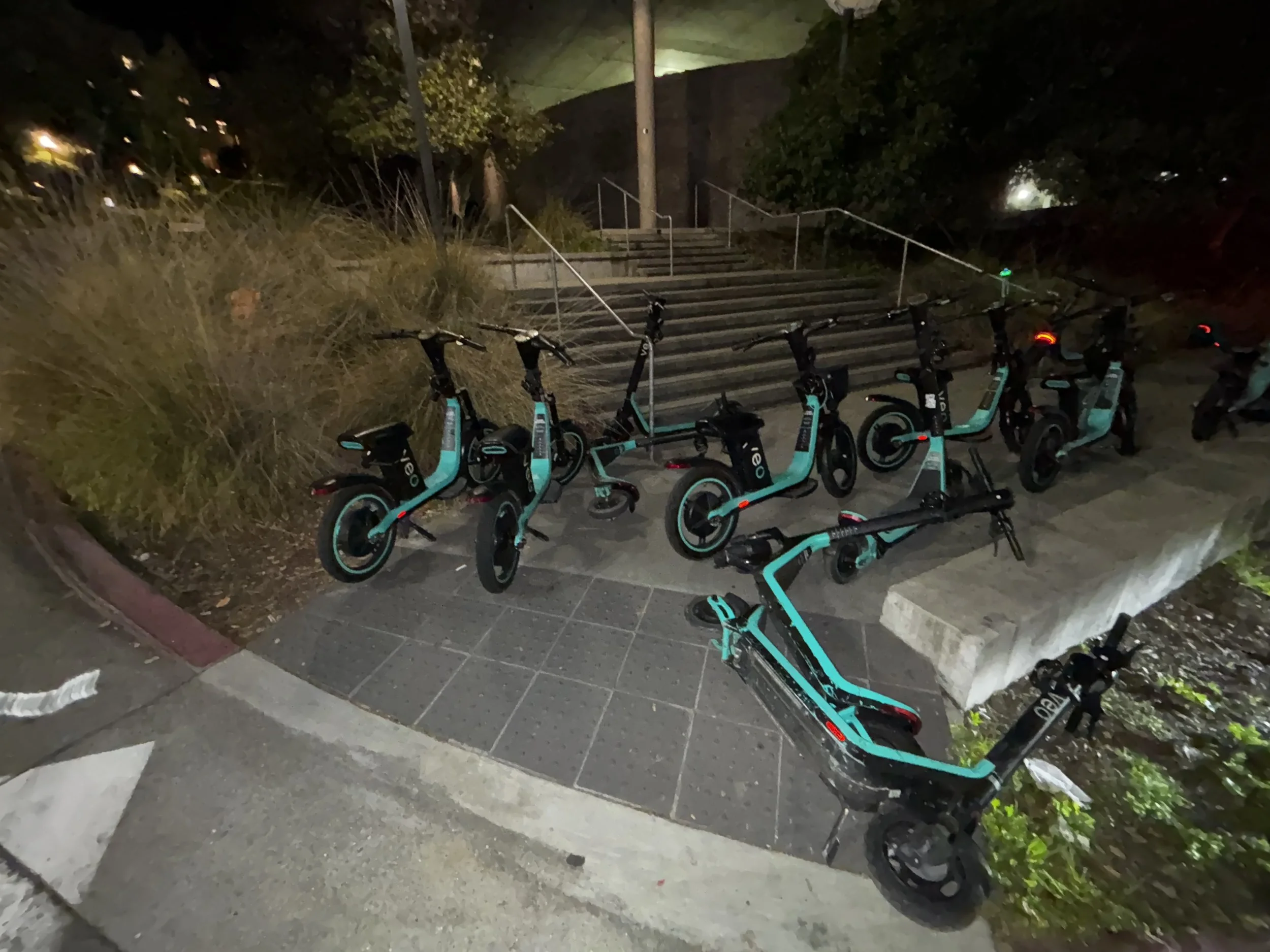
Sidewalks become obstructed in different ways. During move-in and move-out, discarded furniture and overloaded collection areas can narrow the path. Throughout the year, shared scooters left across sidewalks, curb ramps, bus stops, and building entrances can create the same problem. A scooter may be useful transportation for one person while becoming a barrier for someone using a wheelchair, walker, stroller, or cane.
Berkeley’s shared scooter rules require scooters to be parked upright, close to the curb, and at a bike rack or designated parking zone. They may not block sidewalks, doorways, driveways, accessible routes, bus stops, or streets. The City also requires scooter companies to respond to parking complaints within established time limits and can fine companies for permit violations.
Those rules create a response process. They do not tell residents whether recurring obstruction locations remain clear, how quickly reported scooters are removed, or whether repeated violations lead to better parking infrastructure and stronger enforcement.
When elected, I will request a Southside sidewalk-clearance plan that connects seasonal waste operations with shared-scooter parking and enforcement. Move-in and move-out planning should provide collection schedules, reuse locations, adequate building service, and protected accessible routes. Scooter planning should use complaint and operating data to identify recurring obstruction locations, install marked parking zones or corrals, require parking verification and geofencing where appropriate, and prioritize inspections around curb ramps, transit stops, and heavily used pedestrian routes.
Residents should have one clear reporting process and should be able to see whether an obstruction was removed, relocated, or referred for enforcement. Scooter operators should be held to the response and parking requirements of their City permits.
After each major move-in and move-out cycle, and through regular scooter-program reporting, I will seek public information on blocked-route complaints, response and clearance times, recurring locations, parking zones installed, operator violations, enforcement actions, collected material, participation, and actual costs. A sidewalk is not clear unless everyone can use it.
Care Must Work Across Campus and City
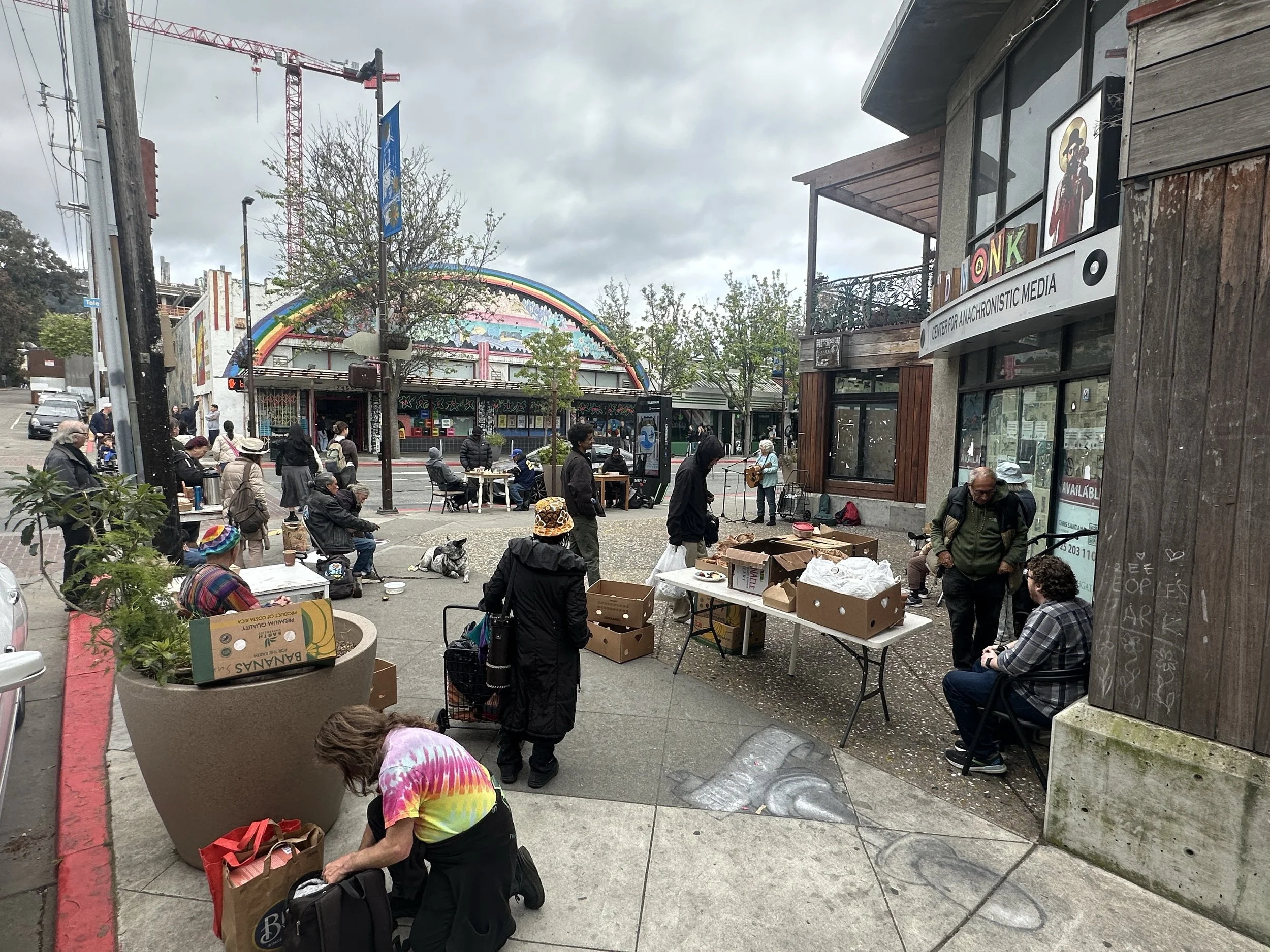
Community care often begins before a crisis call. It can be a shared meal, someone checking in, help completing a form, a safe place to sit, or a trusted connection to professional support. These relationships give people somewhere to begin when a formal system feels distant or difficult to navigate.
The City still has a specific responsibility. It funds and coordinates public services, maintains public spaces, connects residents to County programs, and can identify where existing systems leave gaps. Berkeley directs people experiencing a mental-health crisis to 988 and Alameda County’s Crisis Assessment and Transport Team, while acknowledging that the City does not manage the County team and that availability varies. UC Berkeley provides students with counseling, urgent support, and an after-hours assistance line. Community groups should not be expected to replace either institution.
Formal services also cannot replace community relationships. Students may know campus resources but not City services. Other residents may not be eligible for campus programs. People without stable housing may face additional barriers to both. Students graduate, leases turn over, and volunteer groups change. Southside needs connections that survive those transitions.
When elected, I will seek a Southside Community Care Network connecting City and UC services with student organizations, neighborhood groups, service providers, cooperatives, faith communities, businesses, and mutual-aid organizations. The network should maintain a clear resource map, dependable referral contacts, regular coordination, and a public process for identifying unmet needs. The City can support this work through appropriate grants, access to public space, storage, sanitation, communications, and staff coordination. UC and student organizations should contribute campus resources and continuity plans that do not disappear when student leadership changes. Community organizations should retain their independence and should not become unpaid substitutes for public agencies. Progress should be measured by whether people reach food, housing assistance, health care, crisis support, peer support, and continuing care. Privacy-protecting reports should identify completed referrals, service gaps, hours of coverage, organizations supported, and problems requiring City or UC action. The City should provide dependable services. Community care networks should make sure nobody has to find those services alone.
Prepare Before an Emergency
People need to know how their building and neighborhood will respond to a fire, earthquake, power interruption, severe smoke, or another major disruption. Emergency preparation has to remain understandable as residents move and new students arrive. A plan filed away years earlier will not explain itself to someone who has just received their keys.
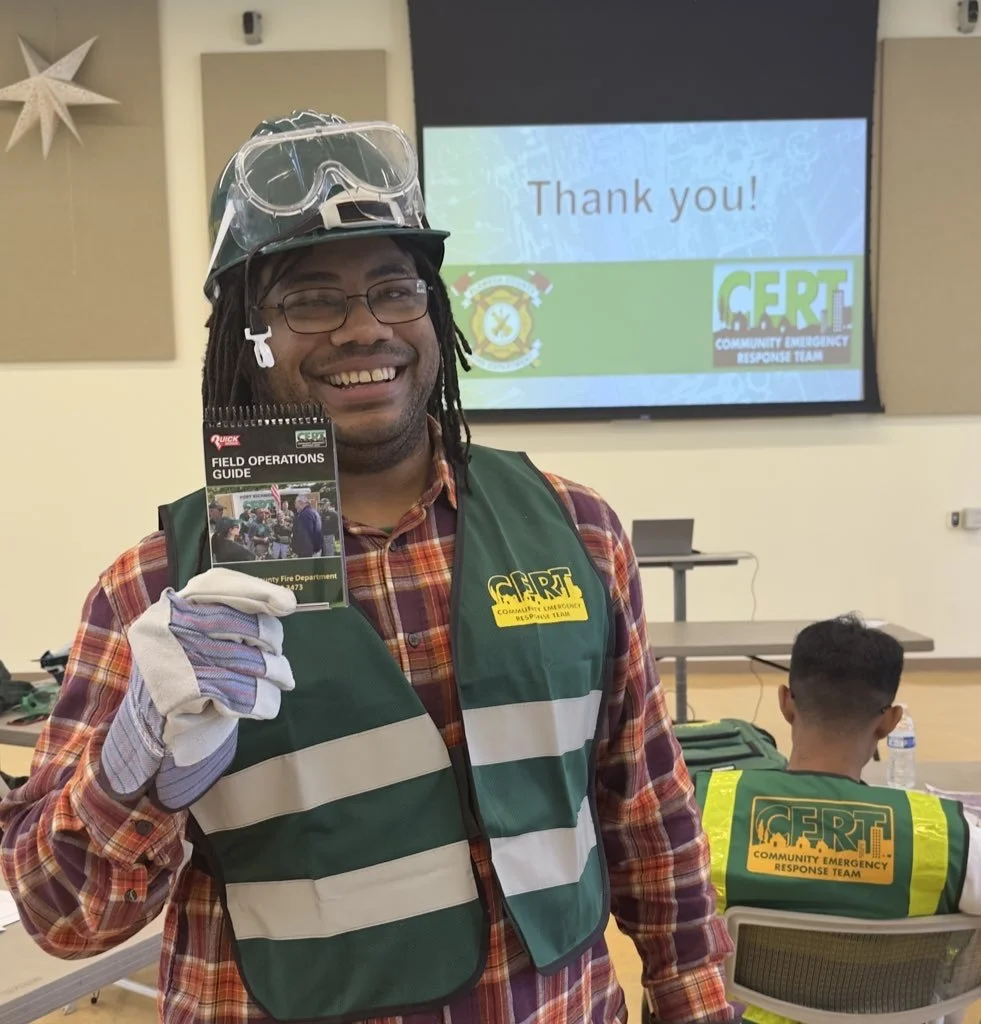
I will seek a Southside readiness program connecting City emergency staff, UC, property owners, cooperatives, businesses, and neighborhood groups. It should build on Berkeley Ready and CERT training with recurring education, clear building information, and exercises that test communication and coordination. Property owners must remain responsible for their buildings.
Accessible evacuation planning needs to be developed with disabled residents and qualified personnel. It should address assistance needs, communication, and alternatives appropriate to the building or location. Multilingual information and current alert procedures should be part of the work, with personal details protected from unnecessary disclosure.
The 2020 emergency-response Measure FF supports emergency and preparedness functions. I will seek review of eligible funding for this work alongside existing commitments. Each exercise should end with an assigned correction list and follow-up dates. Preparation becomes useful when the problems it identifies are addressed.
Growth Must Come With Working Services
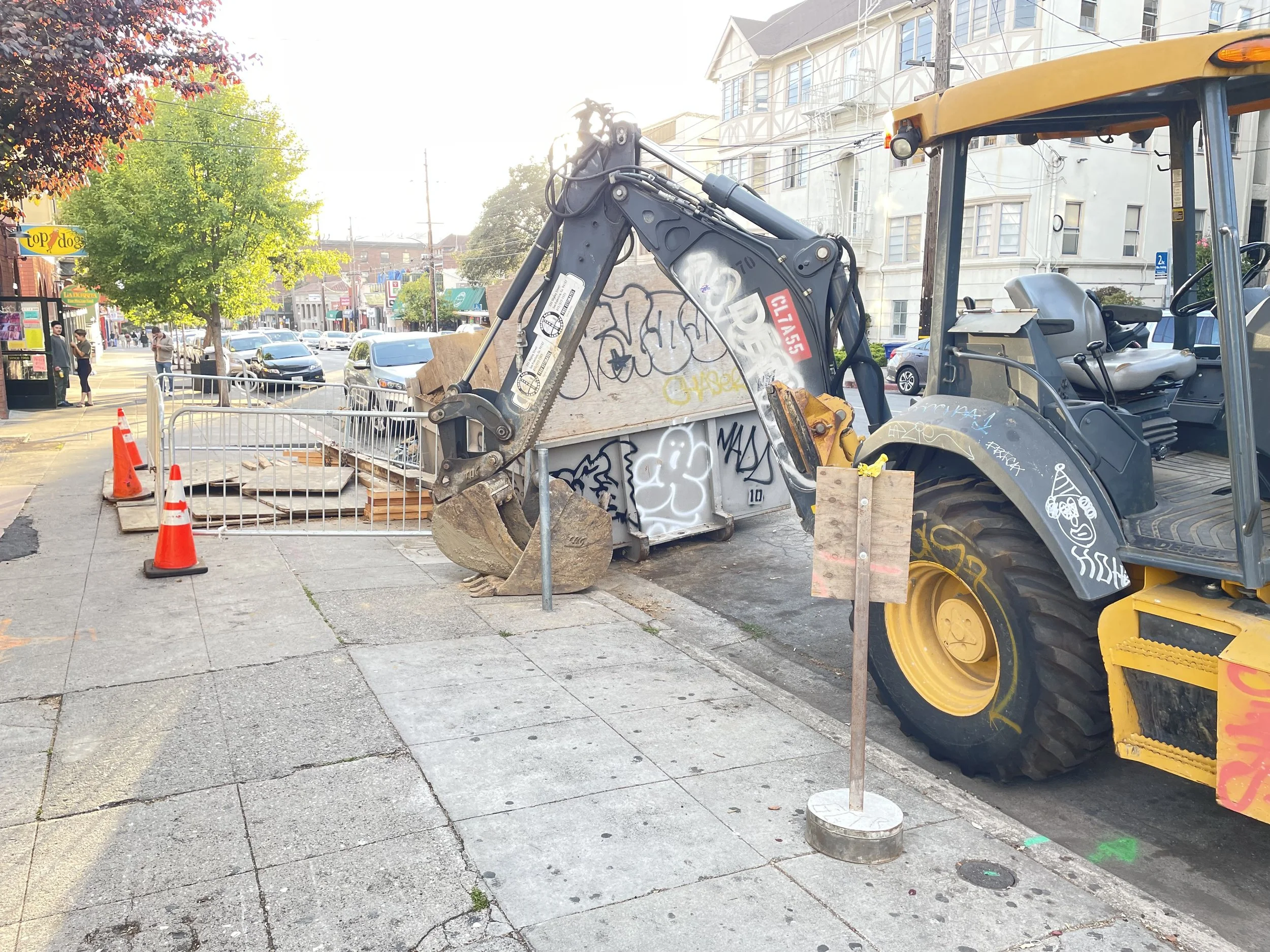
Adding homes changes how streets, utilities, and public services are used. Construction can also change access before a building opens. Major projects should identify those effects early, showing how people will move safely during the work and how added demand will be served afterward.
For City-reviewed projects, I will pursue a standard service-impact checklist covering accessible detours, loading, waste, lighting, drainage, trees, transit, and emergency access. Staff should identify current requirements and any needed changes, including legally supportable fees or contributions. The public should be able to see which costs belong to the project, which are shared, and who will maintain the resulting improvements.
UC requires a separate approach. The City-UC framework provides a route for early meetings, project checklists, commission review, and written City comments on covered projects, while the University retains its land-use authority. I will use those opportunities to seek specific service commitments and bring a costed neighborhood needs list into the City's discussions with UC. I will report where agreement has and has not been reached.
Existing student housing belongs in that discussion. UC's current Units 1, 2, and 3 page describes Unit 3 as four high-rise buildings around a central courtyard. I will request a resident-informed condition and disability-access review, repair-time information, and a funded renewal scope with a phasing schedule. The review should distinguish routine repairs from larger modernization needs and explain how residents would be accommodated during the work.
Fund the Work Beyond Opening Day
A new crossing, a repaired sidewalk, and a seasonal collection program have different funding needs. Some costs occur once; others return every year. The budget should distinguish them so that approving construction does not leave a department without the resources to keep the improvement working.
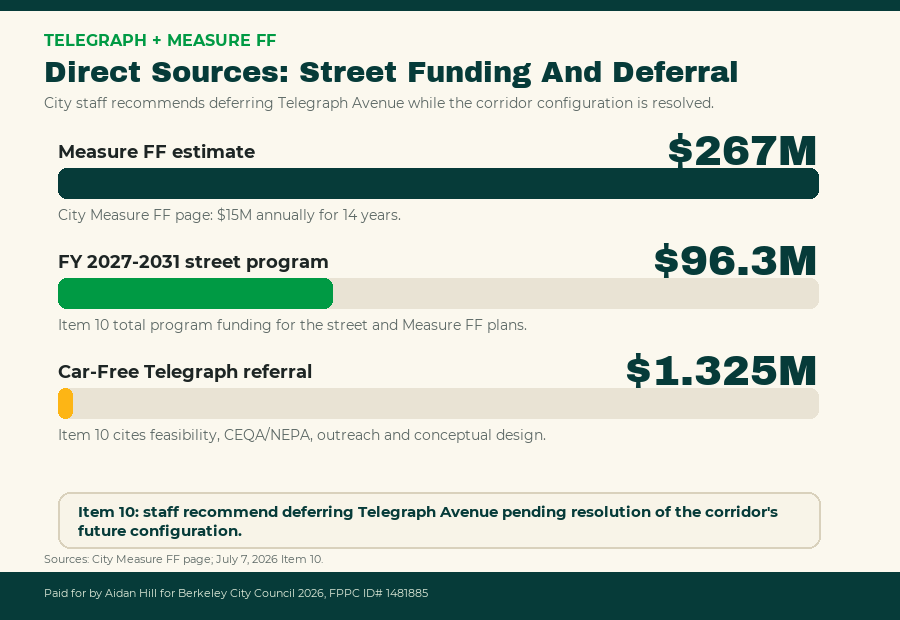
The 2024 street-and-sidewalk Measure FF allocates 45% to streets, 15% to sidewalks and pedestrian paths, 30% to safety, and 10% to environmental enhancements and other permitted uses. It also provides for an oversight committee, annual performance reports, public workshops, and periodic audits. This is a different measure from the 2020 emergency-response tax, and the two funds should remain separate.
I will seek a costed District 7 program that identifies eligible sources, existing obligations, staffing, project readiness, and long-term maintenance. A revenue estimate is not an available balance. When a proposal needs additional money, I will ask for the alternatives and consequences to be made public, including effects on other services.
The sequence is straightforward: establish the need, assign responsibility, decide how to pay for the work, and track delivery. Public reporting should show the decision residents are waiting on. That gives the Council a basis for correcting delays and the community a way to judge whether priorities are being carried out.
What Success Would Look Like
Success would mean a resident can travel along a dependable route, use a working crossing, and get a clear answer when something fails. After a move-out period, sidewalks would remain usable and unwanted items would have an appropriate destination. These are ordinary conditions that City government should organize itself to provide.
I will seek quarterly reporting on response and repair times, requests older than 30, 60, and 90 days, repeat locations, and completed access improvements. The report should distinguish temporary protection from permanent work and explain why some locations remain unresolved. District comparisons should help identify uneven service rather than reward only the places that submit the most reports.
Crisis-response reporting should show coverage and appropriate connections to care while protecting privacy. Emergency-readiness reporting should identify exercises held and corrective actions completed. Capital reporting should show budgets, schedules, responsible agencies, sponsor contributions, and who will maintain the result.
The test is whether conditions improve and stay improved. A lower complaint count alone cannot establish that. I want public data, field checks, and residents’ experience considered together, so Berkeley can identify successful work and correct what is still failing.
Reliable Services, Block by Block
Southside deserves services that match how the neighborhood is used. When elected, I will connect each priority to a responsible department, a funding decision, a schedule, and a way for residents to check the result.
City services earn trust through follow-through. The public measure is whether an ordinary problem gets fixed and stays fixed.
Care must reach beyond a phone number or referral. It must reach the person, support the people who keep showing up, and hold public institutions responsible for doing their part. When elected, that is the standard I will bring to City Hall.
Aidan Hill
-
Links checked September 15, 2026. Program pages establish current design and published responsibilities; they do not by themselves prove service performance at every location.
City Information Technology Department and 311 Customer Service Call Center
Southside Complete Streets project, scope, completion, and funding
City Crisis Services: 988 and Alameda County CATT referral information
Berkeley Ready and Community Emergency Response Team training
2024 Measure FF: streets, sidewalks, safety, and environmental improvements
Commissioner Micael’s published issues page, accessed September 15, 2026