

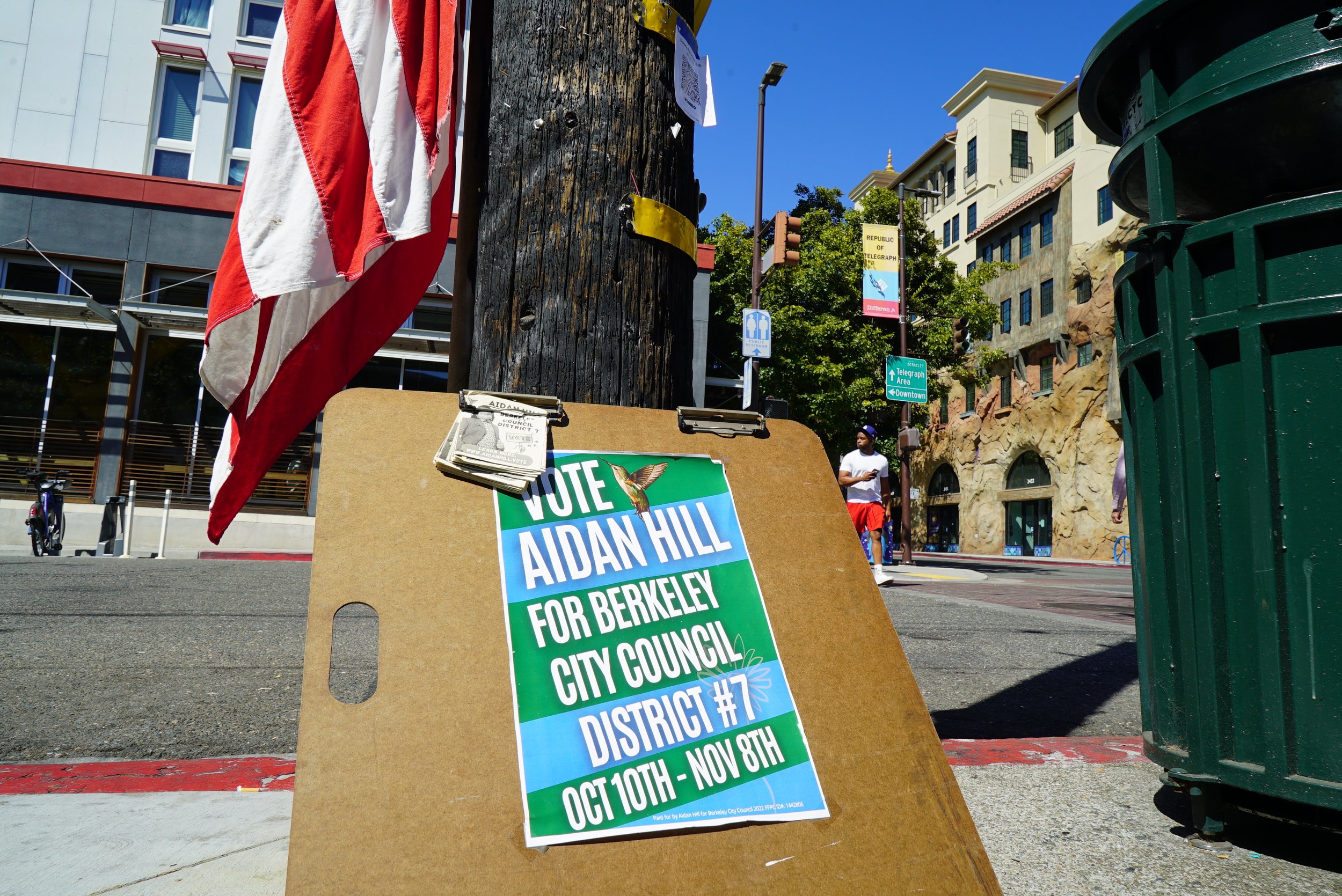
Aidan Hill’s November 2026 voter guide for Berkeley

A ballot measure can authorize billions of dollars in debt, change who may vote, protect a tenant, fund a bus route, or alter a few lines of Berkeley’s charter. The consequences show up in ordinary life long after the campaign mail stops.
I live on Telegraph, work as a medical case manager, organize with East Bay Food Not Bombs, and have spent years defending People’s Park and Southside. That work has taught me to ask what a public program actually reaches, who is left outside it, and whether government reports the difference between money promised and results delivered.
On November 3, Berkeley voters will decide 14 statewide propositions, one regional transit measure, and seven City measures. My recommendations are:
Yes on state Propositions 1, 2, 3, 4, 5, 37, and 40
No on state Propositions 38, 39, 41, 42, 43, 44, and 45
Yes on regional Measure RTM
Yes on Berkeley Measures U, V, W, X, Y, Z, and AA.
I reached these positions by looking at what each measure would actually do, who would carry its costs, what public result it could produce, and what would still depend on government after the vote.
My standard is simple: public money must produce public results. A tax or bond can create a tool, but it does not repair a sidewalk, keep a tenant housed, support an artist, or make healthy food easier to reach by itself. Those results require priorities, public budgets, maintenance, and follow-through.
State Propositions
-
I support Proposition 1 because California needs more affordable rental housing, supportive housing, preservation, veterans’ mortgages, and downpayment assistance. Housing programs at this scale require durable public investment.
Proposition 1 would authorize $11.25 billion in state general obligation bonds. The Legislative Analyst estimates repayment of $500 million to $600 million each year for approximately 25 years. That repayment comes from the state General Fund and includes interest. [Read the official Proposition 1 guide](https://voterguide.sos.ca.gov/propositions/1/)
Debt is a real public cost, and a bond authorization is not a completed home. State and local agencies still have to select programs and projects, combine financing, complete construction, and keep homes affordable for the promised period.
I support the investment with a clear public measure: homes financed, completed, occupied, preserved, and kept affordable at each income level. Berkeley should report what funding it seeks, what it receives, what local resources it must match, and what barriers remain between an award and a home.
-
I support Proposition 2 because a larger reserve can help protect schools, health care, housing, and local services when state revenue falls. Stability matters most when a downturn increases public need at the same time government has less money.
Proposition 2 would raise the state’s mandatory rainy-day reserve target from 10% to 20% of General Fund tax revenue, increase deposits during surges in investment income, and extend additional debt payments through 2040. It would also expand the debts eligible for repayment. [Read the official Proposition 2 analysis](https://voterguide.sos.ca.gov/propositions/2/analysis.htm)
The tradeoff is budget flexibility. Money placed into a mandatory reserve or debt payment is less available for an immediate service or investment. A larger reserve can prevent damaging cuts later, but it should not become an excuse to ignore urgent needs now.
My Yes vote is for long-term service stability with honest reporting. The state should show how much is reserved, which debts are paid, what current spending is constrained, and when reserve withdrawals protect people from cuts.
-
I support Proposition 3 because schools and health care need stable revenue, and people with the highest incomes can contribute more without shifting the burden to everyday purchases.
Proposition 3 would make permanent the existing higher state income-tax rates for individuals earning more than $371,000, with the threshold adjusted annually. Those rates are currently scheduled to expire in 2031. The Legislative Analyst estimates the measure would preserve $5 billion to $15 billion in annual state revenue. [Read the official Proposition 3 guide](https://voterguide.sos.ca.gov/propositions/3/)
The annual amount will change with high-income earnings and the economy. Permanent revenue also does not guarantee that every school, clinic, patient, or student receives the support they need.
The measure keeps a progressive revenue source in place. I will judge its results through school funding, health coverage, access to care, workforce capacity, and the distribution of benefits across communities.
-
I support Proposition 4 because public financing can help candidates compete without depending on large private fundraising networks. Berkeley already has a public-financing system, and state law should not block other communities from considering one.
Proposition 4 would repeal California’s prohibition on public funding for election campaigns. State and local governments could then establish their own programs with safeguards. The measure would not create a statewide program by itself, and it excludes funds earmarked for education, transportation, and public safety. Estimated ongoing state administrative costs are several hundred thousand dollars each year. [Read the official Proposition 4 guide](https://voterguide.sos.ca.gov/propositions/4/)
Public financing still requires rules for eligibility, spending, enforcement, audits, and public reporting. A poorly designed program can remain inaccessible or fail to reduce the influence of private money.
I support giving voters and local governments the authority to build transparent systems. The public should be able to see who qualified, what public funds were used, whether enforcement was timely, and whether the program expanded meaningful participation.
-
I support Proposition 5 because California’s current recall system can remove an official by majority vote and then install a replacement who won only a small plurality in a crowded field.
Proposition 5 would remove the replacement-candidate question from the recall ballot. A recalled governor would be succeeded by the lieutenant governor, who was elected statewide. If the recall occurred early enough in the term, voters would choose a governor at a future statewide election. Legislative vacancies would ordinarily be filled through a separate special election. Other statewide vacancies would follow existing appointment rules. [Read the official Proposition 5 analysis](https://voterguide.sos.ca.gov/propositions/5/analysis.htm)
The tradeoff is that voters would no longer choose a replacement during the recall itself, and some statewide offices would be filled by gubernatorial appointment. A later special election could also cost millions of dollars. The recalled official could not be appointed back to the vacancy.
I support the change because it separates removal from succession and prevents a candidate with a small fraction of the vote from taking office through a crowded replacement field. Recall remains available, while legislative seats and early gubernatorial vacancies return to voters through a separate election.
-
I support Proposition 37 because middle-income households need more routes into homeownership, especially in places where prices rise faster than savings.
Proposition 37 would authorize up to $25 billion in revenue bonds for fixed-rate assistance mortgages covering up to 17% of an eligible newly built home’s price. Borrowers would need to meet income, residence, occupancy, and minimum 3% downpayment requirements. Homeowner repayments would repay the bonds, and the Legislative Analyst estimates no direct state or local cost. [Read the official Proposition 37 guide](https://voterguide.sos.ca.gov/propositions/37/)
This program would serve qualifying buyers of new homes. It would not directly help renters, preserve an existing affordable building, reduce the listed price of a home, or replace the need for social housing and permanently affordable ownership.
I support it as one tool within a larger housing system. Public reporting should show who receives loans, where homes are built, borrower outcomes, defaults, administrative costs, and whether the program expands access across income, race, disability, and geography.
-
I oppose Proposition 38 because it would commit the public to long-term debt while directing half of the bond money to one qualifying UC-affiliated nonprofit research institute.
Proposition 38 would authorize $8.4 billion in state general obligation bonds for immunology research, divided equally between that institute and a grant program. Estimated repayment is $500 million to $600 million each year for approximately 20 years. Research revenue could offset some or all of that cost, but the amount is uncertain. [Read the official Proposition 38 guide](https://voterguide.sos.ca.gov/propositions/38/)
Medical research has public value. The question is whether this financing and governance structure gives the public proportionate control, broad scientific competition, and a reliable return for the debt it assumes.
I support public research funding through transparent appropriations and competitive programs with open governance, access requirements, and clear public ownership of benefits. Proposition 38 does not provide enough of those guarantees for its cost and concentration.
-
I oppose Proposition 39 because eligible citizens should not lose practical access to the ballot through a new identification requirement.
Proposition 39 would require government-issued identification for in-person voting and the last four digits of designated government identification on mail-ballot envelopes. The Legislative Analyst estimates implementation costs ranging from tens of millions to the low hundreds of millions of dollars annually. [Read the official Proposition 39 guide](https://voterguide.sos.ca.gov/propositions/39/)
The measure provides for free voter-identification cards, but a nominally free card still requires documents, time, transportation, and a successful administrative process. Those burdens do not fall evenly, especially on people who are unhoused, disabled, elderly, low-income, or moving frequently.
Election security and voter access both matter. California should verify eligibility through accurate registration, signature review, accessible administration, and accountable audits without building a new barrier between eligible voters and their ballots.
-
I support Proposition 40 because California can ask people with billionaire-level wealth to make a one-time contribution to health care, education, and food assistance.
Proposition 40 would impose a one-time 5% tax on billionaires who were California residents on January 1, 2026, due in 2027 with a more costly five-year payment option. It generally excludes real estate, pensions, and retirement accounts. Ninety percent of revenue would fund health care, with the remainder supporting education, food assistance, and administration. The Legislative Analyst estimates temporary revenue in the tens of billions of dollars over several years, with possible ongoing state income-tax losses below $1 billion annually. [Read the official Proposition 40 analysis](https://voterguide.sos.ca.gov/propositions/40/analysis.htm)
The measure creates administrative and legal complexity, and it does not solve the need for durable progressive revenue. It does direct extraordinary private wealth toward urgent public needs instead of relying on taxes on everyday purchases.
Propositions 41 and 42 may legally conflict with Proposition 40. If either receives more Yes votes than 40, a court could decide that the conflicting measure prevents 40 from taking effect. That is one reason I recommend Yes on 40 and No on 41 and 42.
-
I oppose Proposition 41 because it would make new state special taxes harder to use for the public purposes voters approve.
Proposition 41 would require audits before the election once proponents of a new initiative special tax collect 25% of the required signatures, followed by audits every four years. It would also restrict exemptions from the state spending limit for new special taxes and apply to taxes enacted after January 1, 2026. Initial audit costs are estimated in the low millions of dollars annually, while the overall fiscal effect is unknown. [Read the official Proposition 41 analysis](https://voterguide.sos.ca.gov/propositions/41/analysis.htm)
Audits can improve public accountability. This measure combines them with a constitutional restriction on how voters may raise and use revenue. It also creates a possible conflict with Proposition 40.
I support audits, transparent budgets, and outcome reporting through rules that improve public control. I do not support using those goals to narrow the state’s capacity to meet public needs.
-
I oppose Proposition 42 because the state constitution should not permanently shield broad categories of personal property, including financial assets, from new state taxes.
Proposition 42 would prohibit new state taxes on owning personal property and certain taxes applied retroactively to past activity. It would nullify conflicting taxes enacted after January 1, 2026. The Legislative Analyst concludes that future state revenue could be lower than it otherwise would be. [Read the official Proposition 42 guide](https://voterguide.sos.ca.gov/propositions/42/)
Retroactive taxation can raise legitimate fairness and administration concerns. A broad constitutional ban goes further by removing future choices before the public knows what need, tax design, exemption, or concentration of wealth may be at issue.
The measure may also conflict with Proposition 40. I support fair-tax safeguards and public debate about specific proposals. I do not support a permanent constitutional barrier that protects financial wealth from democratic review.
-
I oppose Proposition 43 because it would make it harder for local voters to fund services they choose.
Beginning January 1, 2027, Proposition 43 would require two-thirds approval for new, increased, or extended voter-proposed local special taxes. Current court decisions allow those citizen initiatives to pass by majority vote. The Legislative Analyst finds that future local revenue could be lower, depending on which proposals reach the ballot and how voters respond. [Read the official Proposition 43 analysis](https://voterguide.sos.ca.gov/propositions/43/analysis.htm)
A special tax should clearly state its purpose, cost, duration, administration, and reporting. Voters should then be able to decide it by majority rule. A one-third minority should not automatically control whether a community can fund a service.
Berkeley depends on local revenue for public health, housing, transportation, arts, and infrastructure. I support strong disclosure and oversight while preserving the democratic authority of local voters.
-
I oppose Proposition 44 because safety-net clinics need accountability that measures patient access, care quality, staffing, and financial practices, not one statewide spending ratio that can penalize a clinic without protecting its patients.
Proposition 44 would require affected nonprofit Federally Qualified Health Centers to spend at least 90% of annual revenue on charitable program services. “Program services” includes more than direct patient care. The Attorney General would administer the rule, and estimated state costs in the low tens of millions of dollars annually would be funded through clinic fees. [Read the official Proposition 44 guide](https://voterguide.sos.ca.gov/propositions/44/)
As a medical case manager, I know that care also depends on scheduling, records, language access, compliance, facilities, billing, technology, and the staff who hold those systems together. The Legislative Analyst identifies possible service reductions or clinic closures among the potential responses.
Clinics should disclose spending, executive compensation, reserves, related-party transactions, patient access, wait times, staffing, and outcomes. Oversight should correct misuse without destabilizing the places low-income patients rely on.
-
I oppose Proposition 45 because faster project delivery should come from capable agencies, clear standards, and early problem-solving, not weaker public review and narrower legal remedies.
Proposition 45 would change California Environmental Quality Act procedures for designated housing, transportation, water, health, and other projects. It would shorten review and litigation timelines and narrow the scope of court review. Initial state and local costs are estimated in the high tens of millions of dollars annually and could exceed $100 million, partly offset by fees. Longer-term effects remain uncertain. [Read the official Proposition 45 guide](https://voterguide.sos.ca.gov/propositions/45/)
California needs housing and infrastructure. It also needs meaningful alternatives analysis, tribal consultation, public participation, and remedies when agencies fail to follow the law. A speed requirement without enough institutional capacity can shift costs onto communities and ecosystems.
I support predictable review deadlines, complete applications, early consultation, adequate staffing, and transparent resolution of disputes. Those changes can improve delivery while preserving the public’s right to understand and challenge environmental harm.
Regional Measure
-
I support Measure RTM because reliable transit is basic infrastructure. District 7 residents use AC Transit and BART to reach work, school, health care, housing, and daily needs. A regional system cannot remain useful if major operators answer operating deficits with deep service cuts.
RTM would add a 0.5 percentage-point sales tax in Alameda, Contra Costa, San Mateo, and Santa Clara counties and a 1 percentage-point tax in San Francisco for 14 years. In Berkeley, the added tax would equal 50 cents on a $100 taxable purchase. The ballot estimate is approximately $980 million each year across the five-county district, and the measure requires a majority vote. [Read the official Alameda County election notice](https://acvote.alamedacountyca.gov/acvote-assets/02_election_information/PDFs/20261103/Measures/public_transit_revenue_measure.pdf)
Sales taxes take a larger share from people with less income. That cost must be weighed against who is hurt when buses and trains become less frequent, less reliable, or unavailable at the hours people need them. The measure directs Alameda County revenue to BART, AC Transit, smaller bus operators, ferries, fare programs, accessibility, wayfinding, transit priority, and county transportation work. It also requires an independent oversight committee and financial-efficiency reviews. [Read the official measure record](https://mtc.ca.gov/about-mtc/authorities/public-transit-revenue-measure-district)
When elected, I will press Berkeley to coordinate street design, signals, loading, accessibility, and construction with transit operators. Regional funding should show up as service people can count on. The public should be able to track frequency, reliability, affordability, accessibility, allocations, and the corrective action taken when an operator falls short.
Local Measures
-
I support Measure U because residents should be able to see and use the results of public investment. In Southside, that means accessible sidewalks, safer crossings around Telegraph, public restrooms, shade, better drainage, reliable facilities, and public spaces that can serve people every day and during an emergency.
Measure U would authorize up to $300 million in general obligation bonds for public infrastructure and facilities. Property taxes would repay the bonds with interest. The City estimates an average annual cost of $22.14 per $100,000 of assessed value over a projected 40 years, with a peak of approximately $35 beginning in 2040–41. These are estimates, and assessed value is different from market value. U is the only one of these seven City measures that requires two-thirds approval. [Read the City Attorney’s analysis, pages 1–2](https://berkeleyca.gov/sites/default/files/Nov%202026%20Impartial%20Analyses.pdf)
The bond can fund parks, accessibility, emergency facilities, seismic work, climate resilience, and other City infrastructure. It does not guarantee any particular project or a fair share for District 7. It also does not automatically provide the ongoing money needed to clean, staff, and maintain everything built with bond funds. [Read Measure U]
When elected, I will press to put Southside needs on the project list before every dollar is committed. Each project should have a public budget, schedule, maintenance plan, and explanation when deadlines move. The required annual reports and recurring audits should help residents determine what was promised, what was spent, and what was completed.
-
Yes on V: Fund services and show where the money goes
I support Measure V because Berkeley needs dependable revenue for the services residents use. A city cannot maintain sidewalks, clean public spaces, respond to emergencies, or keep facilities open through statements of support alone. Services need staff and stable funding.
Measure V would increase Berkeley’s sales tax by 0.5 percentage points, equal to an additional 50 cents on a $100 taxable purchase. The City estimates that it would raise $9 million to $10 million annually beginning April 1, 2027. The tax has no scheduled end date. [Read the City Attorney’s analysis, page 3](https://berkeleyca.gov/sites/default/files/Nov%202026%20Impartial%20Analyses.pdf)
I have a real concern about the way this measure raises money. Sales taxes take a larger share from people with less income, and this revenue would enter the General Fund without being reserved for a named service or neighborhood. That makes the annual budget choices as important as the measure itself. [Read Measure V](https://berkeleyca.gov/sites/default/files/Berkeley_Sales%20Tax%20-%20Full%20Text.pdf)
When elected, I will ask for spending reports that residents can understand and connect to actual services. I will also pursue fairer revenue options for future needs so Berkeley does not treat sales taxes as its default response. Supporting V means keeping services funded while remaining honest about who bears the cost.
-
Yes on W: Lower barriers to local democracy
I support Measure W because running for local office and participating in local government should be understandable and accessible. Election procedures shape who can enter public life, how residents place ideas on the ballot, and whether public campaign financing works as intended.
Measure W would replace Berkeley’s $150 candidate filing fee with the amount set under state election law, currently $25. It would also raise the ceiling for public-financing administration and enforcement from $250,000 to $400,000 per four-year election cycle, subject to cost-of-living adjustments. That is a ceiling for administration and enforcement, not an annual appropriation or a grant to one candidate. [Read Measure W](https://berkeleyca.gov/sites/default/files/Berkeley_Charter%20Amendment%20-Full%20Text.pdf)
The measure also changes procedures for recalls, vacancies, initiatives, referenda, and candidate statements. Because these provisions are bundled together, voters deserve more than a summary that says the rules were “updated.” They deserve to know how each procedure works after passage. [Read the City Attorney’s analysis, pages 4–5](https://berkeleyca.gov/sites/default/files/Nov%202026%20Impartial%20Analyses.pdf)
I will expect the City to publish plain-language instructions for residents and candidates, along with clear reports on public-financing administrative spending. Lower fees matter, but real access also requires rules people can find, understand, and use.
-
Yes on X: Keep tenant rights with the tenancy
I support Measure X because a tenant should not lose established protections simply because a property later meets the terms of an exemption. Housing stability requires rights that stay understandable and enforceable when ownership or property circumstances change.
Measure X would preserve specified rent-control and just-cause protections when a tenancy began before a unit met certain exemption requirements. It would also lower the tenant-association threshold from ten units to five at properties without a management company, protect certain associations when management arrangements change, and allow fee relief for qualifying nonprofit subsidized housing. [Read Measure X](https://berkeleyca.gov/sites/default/files/Berkeley_Rent%20Ordinance%20-%20Full%20Text.pdf)
The protection for later exemptions expressly excludes units deemed exempt before November 3, 2026, and the measure does not eliminate all exemptions. Its 10% provision also does not create a routine right to raise rents by 10%. It limits increases based on accumulated Annual General Adjustments, while Berkeley’s ordinary formula remains 65% of the relevant Consumer Price Index increase with a 5% ceiling. [Read Measure X, pages 5 and 7–8](https://berkeleyca.gov/sites/default/files/Berkeley_Rent%20Ordinance%20-%20Full%20Text.pdf)
When elected, I will ask the independent Rent Stabilization Board to explain the new rules publicly and make outreach accessible to tenants in smaller buildings. A protection that exists only in ordinance language does not help someone who does not know it applies or cannot navigate enforcement.
-
Yes on Y: Fund the arts and open the door wider
I support Measure Y because art is part of public life. People need places to make things, hear music, see performances, and share culture without every gathering depending on private wealth or a commercial purchase. As a former reentry and transfer student at UC Berkeley, I also know students are part of this city’s cultural life.
Measure Y would establish a 12-year parcel tax of 7 cents per square foot of property improvements beginning January 1, 2027. It would direct 75% to qualifying performing arts organizations, 5% to individual artists and other arts organizations, 10% to capital projects, 5% to community festivals, and 5% to administration. The text contains no automatic inflation adjustment and includes several exemptions. [Read Measure Y](https://berkeleyca.gov/sites/default/files/Berkeley_Arts%20Tax%20-%20Full%20Text.pdf)
I disagree with excluding full-time students from individual artist grants. Other grant categories also limit activities aimed primarily at enrolled college or university students. Those exclusions do not prevent students from attending all funded public programs, but they leave a real access gap for people who live here, create here, and contribute to Berkeley. [Read the City Attorney’s analysis, pages 8–9](https://berkeleyca.gov/sites/default/files/Nov%202026%20Impartial%20Analyses.pdf)
The Council generally cannot promise to rewrite that eligibility rule after passage. I will advocate for separate City and UC opportunities for student artists, accessible grant outreach, and public reporting on who receives funding. Supporting Berkeley’s arts should include established institutions, working artists, small organizations, festivals, and people still finding their audience.
-
Yes on Z: Make public money serve public needs
I support Measure Z because public money should be able to finance public priorities. Affordable housing, green infrastructure, and small businesses often need patient financing that is not designed around the fastest private return.
Measure Z would create a six-year parcel tax to capitalize and support a public bank. Initial rates would be up to 6 cents per square foot of residential improvements and 9 cents for nonresidential improvements, with exemptions. Annual increases could reach the greater of Bay Area cost-of-living growth or statewide per-capita personal-income growth. [Read Measure Z](https://berkeleyca.gov/sites/default/files/Berkeley_Public%20Bank%20-%20Text.pdf)
A Yes vote would create a funding mechanism. It would not itself obtain state authorization for a bank, guarantee lower-cost loans, or eliminate financial risk. If authorization had not been secured by June 30, 2033, the fund could make qualifying loans until authorization was secured. That is a lending fallback, not an automatic refund. [Read the City Attorney’s analysis, pages 10–11](https://berkeleyca.gov/sites/default/files/Nov%202026%20Impartial%20Analyses.pdf)
Before funds are committed, I will press for transparent lending standards, governance rules, authorization milestones, and risk reporting. Annual reports should show how much was collected and spent, who received financing, and whether funded projects produced affordable housing, climate resilience, and stable local businesses.
-
Yes on AA: Put prevention and healthy food within reach
I support Measure AA because prevention should be part of public health. In my work as a medical case manager and through East Bay Food Not Bombs, I see how health is shaped by what people can afford, what food is available, and whether support reaches them before a preventable problem becomes a crisis.
Measure AA would replace Berkeley’s existing 1-cent-per-fluid-ounce general tax on sugar-sweetened beverage distribution with a 2-cent special tax. It would dedicate revenue to specified health, nutrition, and drinking-water programs. The City estimates approximately $2.2 million in total annual revenue, with collection beginning April 1, 2027. [Read the City Attorney’s analysis, pages 12–13](https://berkeleyca.gov/sites/default/files/Nov%202026%20Impartial%20Analyses.pdf)
The tax is imposed on distributors, though costs may appear in consumer prices. At least 42.5% of revenue is designated for eligible community organizations or City departments. Another 42.5% may be allocated as grants to Berkeley Unified School District, and up to 15% may support administration. The expert panel recommends grants, while the Council approves them. [Read Measure AA](https://berkeleyca.gov/sites/default/files/Berkeley_Soda%20Tax%20-%20Full%20Text.pdf)
I will ask for reports that go beyond dollars awarded. Residents should be able to see which neighborhoods and schools gained access, whether healthy food and drinking water became easier to reach, and what measurable health results followed. Prevention works when programs are accessible and the public can see their effect.
How I reached these recommendations
How I reached these recommendations
A ballot title states the purpose its authors want voters to remember. The legal text determines what government may collect, spend, require, prohibit, or accelerate. I asked the same five questions of every measure:
What would actually change? What authority would the measure create? Which rules would it add or remove? What would remain for agencies, elected officials, courts, or future voters to decide?
Who would pay, and for how long? I considered taxes, debt, fees, administrative costs, and the effect of placing a rule in the state Constitution.
Who would receive the benefit? I looked at eligibility, exclusions, unmet needs, and whether access would depend on later funding or administrative choices.
Who would control implementation? I looked for clear responsibility, public oversight, reporting, enforcement, and a way to correct problems.
What result should residents be able to see? Revenue and appropriations begin the work. The public should be able to track homes preserved, transit service maintained, streets repaired, tenants reached, grants awarded, loans repaid, and health outcomes improved.
For its factual foundation, this guide uses official ballot text, the nonpartisan Legislative Analyst’s Office, and state, regional, and City records. Campaign arguments help explain the competing values. My recommendations rest on the legal mechanism, the way it is financed, the authority it grants, and the public result it can produce.
-
State, regional, and local decisions meet in the same ordinary day. State policy shapes housing, health care, taxes, elections, and environmental review. Regional decisions shape whether BART and AC Transit can provide dependable service. Berkeley measures determine whether the City can fund infrastructure, tenant protections, arts, public-purpose lending, health programs, and daily services.
I asked what each measure would mean in Southside, where growth and institutional pressure have moved faster than public infrastructure. Does it help residents remain housed? Does it protect the right to vote and participate? Does it keep transit running? Does it give the neighborhood more reliable services and public space? Does it require institutions receiving public money or authority to show what they delivered?
That standard led me to support public investment, progressive revenue, housing assistance, transit operations, tenant protections, arts, preventive health, and local infrastructure. It also led me to oppose new voting barriers, permanent restrictions on public revenue, a two-thirds threshold for voter-led local funding, a rigid clinic-spending mandate, and weaker environmental review.
-
Every recommendation has a tradeoff. Proposition 1 uses long-term debt. Proposition 2 reduces some budget flexibility. Proposition 37 helps a limited group of homebuyers. Measure RTM and Berkeley Measure V rely on sales taxes, which take a larger share of income from people with less money. Measure U creates infrastructure funding without guaranteeing that Southside projects will be selected.
Passing a measure creates authority, revenue, or a new rule. Delivery still depends on budgets, staffing, regulations, contracts, outreach, oversight, and maintenance. When elected, I will ask for an implementation calendar for every Berkeley measure that passes, including the responsible department, major decision dates, expected revenue, and the first public report. I will also request a public briefing on how approved state and regional measures affect Berkeley’s budget, services, housing, transportation, and legal responsibilities.
**My standard is whether a measure gives the public a useful tool, distributes its costs fairly, protects democratic participation, and creates results residents can verify.
-
The public record should show every stage between a campaign promise and a public result:
what voters authorized;
what revenue was collected or debt issued;
what government appropriated;
what agencies and contractors spent;
what was delivered, where, and for whom;
what results followed; and
what corrective action occurred when work was delayed or ineffective.
What success should look like
When elected, I will work with residents, fellow councilmembers, City staff, commissions, the independent Rent Stabilization Board, regional agencies, state representatives, and community organizations to make that record visible. I cannot promise how each institution will act. I can make requests in public, identify budget priorities, press for clear responsibility, and report what was approved, funded, delayed, completed, or denied.
Success should be visible in daily life: housing people can afford, transit they can count on, elections they can access, sidewalks they can use, services that remain available, tenants who understand their rights, artists who can find support, and health programs people can reach.
A ballot measure is a governing choice. Public responsibility continues after the votes are counted.
Read more about my governing priorities and help share this guide with your neighbors: www.aidanhill.vote/join
Aidan Hill
Official Sources
The City’s November 2026 ballot-measure directory links the full text of U, V, W, X, Y, Z, and AA, along with the City Attorney’s impartial analyses
Election dates and voting information are available from the Alameda County Registrar of Voters
This voter-information page is provided by Aidan Hill’s campaign. It is not an official government election website.